Celtic Cross
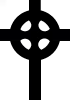
Quite creepy; hence its attraction to the present-day Goth subculture.
Other names of the Celtic Cross

An ornamented standing stone cross, often with a circle is called a High Cross. There are various other names, including Iona Cross, Scottish Cross, Irish Cross, Welsh Cross, Anglican Cross, St. Luke's Cross, St. John's Cross, Halo Cross, Sun Cross... and a few more names which we mention below. The cross arms may extend beyond the circle or terminate at the circle, in which case it can be referred to as a Disc Cross.
In Germany and Netherlands, it's called the Keltisch Cross, and as the Gaelic Cross in various other countries. The design is popular in Ukraine and adorns the tops of cupolas, where the circle sometimes has rays emanating out, much like a Glory Cross.
Other Celtic crosses have the rays pointing inwards, intertwining with each other to form intricate swirls.
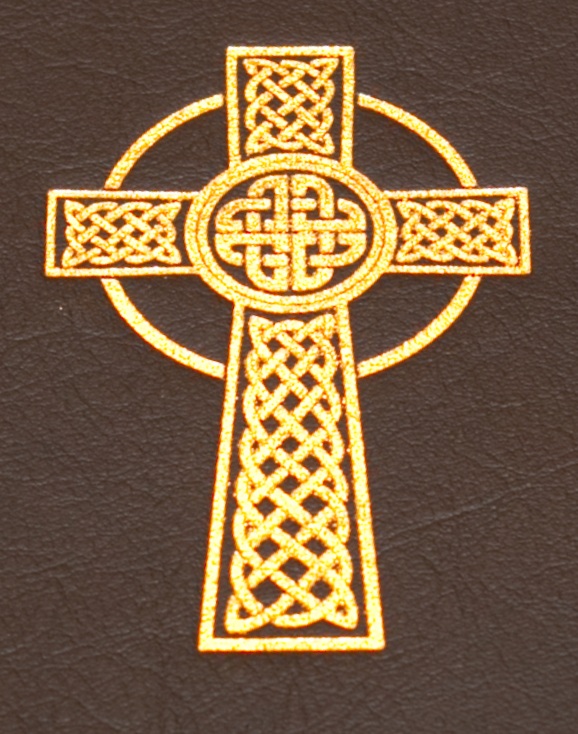
(Click photo
to enlarge)
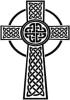
One such example is seen on this old Bible from a great early-20th century Nonconformist minister in Falkirk and Aberdeenshire, Scotland, and carefully renovated for us by Hollingworth & Moss bindery in Leeds, England (now Spink & Thackray - same craftsmen). For this particular work, even though the gilded cross is embossed on leather, the fine detail of the swirls is quite sharp, as one expects from a renowned bookbinder.
Such knotwork can also be found carved on the Pict Cross, Carolingian Cross, the Sun Cross and the Crown of Thorns Cross
Anglicans and Episcopalians usually call this the Anglican Cross, Episcopal Cross or Celtic Cross, whereas Catholics often refer to it as the Irish Cross. But just as the Protestant Christ is the same as the Catholic Christ is the same as the Lutheran Christ, the meaning of the Cross is the same, whatever name we give it.

Monreith Cross
Other names include St. Columba Cross, after the 6th century Irish missionary, Iona Cross, Ionic Cross - sometimes mistakenly called an Iconic Cross, although no doubt many pilgrims have treated this cross as an icon.
One of the oldest Celtic Crosses is found in Whithorn, a former royal burgh in Dumfries and Galloway, Scotland. This is the site of the 4th century Candida Casa, the first recorded Christian church in Scotland, and called the Monreith Cross (or Whithorn Cross).
Churches in Scotland and Ireland are often dedicated to St. John and therefore a Celtic Cross in those churches might be called St. John's Cross. Confusingly, during the First Crusade, there was an order of medieval monks known as the Order of St. John of Jerusalem who used the Maltese Cross as their emblem. That emblem is also referred to as St. John's Cross.

Another name is the St. Peter's Cross, although St. Peter is usually associated with an inverted cross. An example can be seen outside the Cathedral of St. Peter-in-Chains, Peterborough, Ontario, Canada. (Click the photo on the right to enlarge.)
On the lawn there's a bronze statue named "Christ the King", erected in 1926. The artist's name is unknown but it was purchased by Bishop O'Brien when visiting Rome circa 1925. The statue was his gift to the Diocese for their 100th anniversary of the first Mass celebrated in Peterborough on 5 June 1826.


Statue base
Photos by C M Diamond, Peterborough, Ontario
Its white Canadian granite base is by a local monument maker, an Irishman, who formed an incuse image of a Celtic cross in the stone and then poured molten lead into the hollow. There are two such crosses on this monument. The arms are shaped like nails, representing the nails that were driven into Jesus on the cross. (See also Nails Cross)


Photo by the Rev. M Paul Jensen, Bridgewater, Nova Scotia
On the right is another circled cross with nails and also from eastern Canada. It is the only survivor of four that were mounted on gables of St. Paul's Lutheran Church in Bridgewater, Nova Scotia. The church was built in 1906 and several parts have recently been restored, including this wooden cross.
A special feature is its centre. Most Celtic crosses have intersecting arms but in the centre of this one, we see a voided cross in the shape of four buds. This may represent the Lutheran Rose, or as the Rev. Jensen of the church suggests, it could also represent the four gospels. It is a common design found throughout his church. (See stpaulsbridgewater.ca)
Nova Scotia happens to lead us to another saint associated with the Celtic Cross - St. Brendan. You may have noticed that the above crosses resemble a ship's wheel or points of a compass. Well, St. Brendan might have been the first European to sail across the North Atlantic. See the story of St. Brendan and his legendary journey across "the pond".
Celtic Lands

Workman Cross
Photo by Liam Lochinvar
'Celtic' is an Indo-European language that pre-dates Christianity and was used extensively in western and central Europe. Crosses found in those lands retain elements of the pre-Christian culture and assume the name 'Celtic Cross'. Early examples are found in Ireland where, in the 8th century (or possibly earlier), missionaries erected these stone crosses to mark preaching stations and monasteries. (See also Wayside Cross.)
The Workman Cross on the left is in Belfast's City Cemetery. Celtic Crosses are also found in churchyards and market squares in lands such as Wales, the south-west of England and Scotland. The stone used for these crosses in western Britain is usually local sandstone - relatively soft and easy to carve intricate and beautiful designs. The basic construction is simply a Latin Cross with a ring. The meaning of the Cross is well known, but what is the ring?
Meaning of the Celtic Cross
Because of its antiquity, the Celtic Cross is popular with Neodruids, occultists, Neopagans and New Age followers, who see the ring representing the thunder god Taranis and refer to the cross as a Taranis Wheel. (See also Kabbalah Cross and the St. Brighid's Cross.) When a circled cross is seen to represent the Cosmos, several religions refer to it as a Mandala Cross. (See also Sun Cross.)
Another interpretation is that the cross might be an astrological navigation instrument. (See also Navigation Cross)
The most common Christian interpretations of the ring include:
- a symbol of eternity that emphasizes the everlasting life in heaven for those who accept Christ
- the world, for which Christ died and the everlasting love of God, as shown through Christ's Crucifixion.
- The circle has been linked to the idea of the Eucharist. Early Crosses in Scotland depicted round millstones used for grinding wheat that were hung in the centre of large Crosses.
- a crown of thorns
- the resurrection of Christ
- a halo
- a circular fylfot, commonly called a swastika, where the curved "forearms" lengthen to form a circle
- the story of St. Patrick, living with some new Christian converts (formerly Druids). Patrick took one of their standing stones etched with a circle that symbolised their moon goddess, and scratched a Latin cross mark over the circle. This was to show that Christianity had replaced their Pagan beliefs.
- and perhaps the most compelling symbolism; as a Celtic version of the Chi Rho. We are told by Dr Alexander Roman about archaeological sites of Celtic Christian monastic dwellings where the Chi Rho and Celtic Crosses are traced in stone one above the other. The circle in the Celtic Cross is therefore the 'P' of the Chi Rho.

The original St. John's Cross at Iona Abbey.
(Photo by Dennis Turner, reproduced under Creative Commons Attribution-ShareAlike 2.0 license)
There is one further, albeit unlikely, suggestion about the circle; that it might be simply a structural support for the horizontal arms.

One of the best-preserved Celtic crosses is the 8th century St. Martin's Cross (photo on the left), which stands in front of Iona Abbey. This is a replica of the earlier St. John's Cross, which has an enormous arm span for a stone cross; over two metres.
Without the circle to support the weight of the arms, it is unlikely the cross would have stood for such a long time.
However, we discount that suggestion in favour of a religious symbolism of the circle. If ancillary supports were necessary then straight braces at 45 degrees would be more effective.
Use of the Celtic Cross

CCCB

Church in Wales

The design is used by several Christian organisations, such as the Canadian Conference of Catholic Bishops (CCCB), whose logo (shown on the left) is a Voided Latin Cross with a circular arrangement of letters to form a Celtic Cross.
The Church in Wales (yr Eglwys yng Nghymru) similarly uses a Celtic Cross in their logo, superimposed on the St. David's Cross of their flag.


CCAP

Other churches incorporating the Celtic Cross in their logo designs include: the Church of Ireland (C of I), the Church of Central Africa, Presbyterian (CCAP) and the Anglican Church of Canada (ACC).
Why do Christians use the Celtic Cross
Whilst the circle might have originally represented a moon god, the Sun god, a cosmic wheel, or a phallic symbol plus an association with everlasting life; when the stone crosses were carved by Christians, they were doing so with their Christian God in mind.
Church buildings, hymns, vestments and many other trappings used by the Early Church in Europe were influenced by existing Pagan customs and culture in their art and design. There was no reason to invent anything new to worship the Christian God.
The Church has moved, and continues to move, with the times. Perhaps not fast enough for some people, and too fast for others.
See also The Cross and Eternity by Rev. David Linde.
As Alexander Roman points out, not all Celtic Crosses have a circle. Many, especially large stone ones, do not.
The Fleur-de-Lis Cross is also sometimes called a Gaelic Cross
See Hans's Cross for another cross of St. John the Baptist
See also Cardinal Cross
The photographer, Liam Lochinvar of Belfast, says that "Frank Workman was an industrialist and owned one of the largest shipbuilding yards in Belfast (Workman Clark). He was a strong unionist, was elected High Sheriff of Belfast in 1913, and was involved in the UVF gun smuggling into Larne in 1914 - in fact a consignment of the weapons was stored in the Workman Clark yard. The cross also commemorates his son Lieutenant Edward Workman MC, who died of wounds at Le Touquet, France in 1916."
Christians believe that the cross occurs so often in nature and ancient religious thought, along with many other older religious items, as prefiguring; to prepare humanity for the great sacrifice of Jesus. See Meaning of the Cross.


