St. Peter's Cross
an emblem of Christian humility

(The formal name for this cross is 'Petrine Cross'. St. Peter is also sometimes associated with the Celtic Cross.)

Peter was an early missionary in Asia Minor and the Roman Empire. He founded the Church of Rome with Paul (see also Keys of St. Peter). Emperor Nero saw this new church as a threat and began a campaign to eradicate the troublemakers. Peter was imprisoned, tortured and finally crucified.
Such was his faith, it is believed, that he succeeded in persuading his sadistic captors to change from the normal way of executing prisoners. His brother Andrew was also sentenced to death by crucifixion and he too requested that a cross different to Christ's Latin Cross be used. Therefore we have another cross form, the 'X' shaped St. Andrew's Cross.
It's reported that in 1920, Archbishop Joachim of Nizhny Novgorod was taken by Bolshevik agents and crucified upside down on the Royal Doors of the Cathedral in Sevastopol, a Black Sea port of southern Ukraine.
If a victim is upright when crucified on such an inverted cross, with the arms fastened to the top of the pillar and the feet supported by the lower cross-beam, the torture is compounded, since the lower cross-beam (suppedaneum) ensures the victim has a slow death.
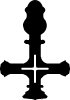
Thor's Hammer
Sometimes this cross is called Satan's Cross because it points downward to Hell. But this is a misnomer for two reasons: Firstly, Hell isn't physically 'down' any more than Heaven is 'up'. And secondly, Satan was not crucified. (That would be crucifiction!) This inverted cross is sometimes used by Satanists to mock the Latin Cross and its meaning.
For Pagans, the upside down cross resembles the Icelandic and Nordic hammer of Thor.
For Christians, as mentioned above, the upside down cross is a reminder to Christians of Peter's incredible display of humility.
Hieromonk Damascene (Orlovsky), Mucheniki, ispovedniki i podvizhniki blagochestiya Rossijskoj Tserkvi XX stoletii, Tver: Bulat, 1992, pp. 168-170


