Gynohierophobia
"Gynohierophobia" is a word we've concocted to describe the fear of women becoming priests. Don't bother writing it down; we're pretty hopeful the word will become obsolete soon.
The proportion of ordained women in the Church is increasing. One day, there will be no female priests - just priests.
But until then, why do some people feel uncomfortable with the idea of a female priest?
Why can't women become priests?

Dawn French, as the Vicar of Dibley
Pre-Christian Greek literature shows that we've been misogynistic for a long, long time, which may be the real reason women have traditionally been kept out of the priesthood, along with other professions of course. Further excuses have been made up, especially when corroboration can be found in the Bible, which used to say quite clearly that women were not worthy for the priesthood. But that was in the past; the Bible doesn't say that now. (More on this below.)
God is often referred to in male terms such as Him and Father, and angels are almost invariably 'male'. The first Christian priest was Jesus, and as far as we know, he never ordained women.
He could have done. His own mother, who witnessed his first miracle and stood with him as he suffered on the cross, or Mary Magdalene, or the women of Bethany. They were all very suitable candidates but all of Jesus' Apostles were men.
A Christian doesn't question why there were no female Apostles. But it seems safe to assume that because 2,000 years ago practically all Pagan religions were led by priestesses, it was important for the Early Christians to distance themselves from the heathens and Pagans, as the Jews had done.
Even today, when talking about the women's ministerial role in the Christian Church, the name "priestess" is avoided in favour of "women priest".
The English word "priestess" goes back only to the 17th century, and coined to refer to the pre-Christian females elders. Even today in Neopaganism, "priestess" is generally only used when the sex of an elder is important to fulfil the role. If the sex of an elder in the Christian Church is important, then that is comparable to Pagan practice.
Let's think back to time of the Early Church and ask:
Why couldn't women become rabbis?
Well of course they can now, and there have been female rabbis outside the Orthodox community since 1972.
In Judaism, men and women have separate roles. A woman's obligations and responsibilities are different from those of a man, but no less important. When Judaism was founded, many Pagan religious ceremonies included raunchy sexual activities. Separation of the sexes in Judaism was seen as a way to help focus more on spiritual concerns, a practice also adopted by both Christians and Muslims.
Women have held respected positions in Judaism since biblical times and the male-only rabbinate stems from the primary role of a woman being seen as wife and mother. Women have been discouraged from pursuing higher education or religious pursuits, primarily because it was felt that would interfere with their role as wives and mothers.
There have been traditions too. Women were omitted from classical smicha - the 'laying of hands' passed down to elders and sages by the first 'rabbi', Moses, and conferred only to men (see Num. 27:15-23). This smicha succession ended around the 5th century and was replaced by various versions in which piety was assumed but not actually tested. Today, a rabbi is not only tested fit to give guidance on matters of Jewish Law and Responsa, but also tested in areas such as sociology, Jewish philosophy, and pastoral care.
So where did Moses get the idea from?
Again, not for the faithful to question, but it's clear that Moses wanted elders to be different from those of the Pagan religions, many of which employed priestesses. Excluding women was one way to establish a distinct and special religion.
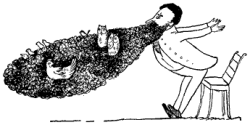
There was an Old Man with a beard,
Who said, "It is just as I feared!?
Two Owls and a Hen,
four Larks and a Wren,
Have all built their nests in my beard."
(Edward Lear)
All sorts of laws were made to accomplish this. Lev. 19 and 21 for example, instruct that beards must not be trimmed. Ancient Middle Easterners illustrated their ethnicity through the facial hair style, so the Jewish custom of pe'ot (side-locks) started off as an identity thing, and still is.
Even before Moses...
Since the time of the earliest humans, the male has been physically stronger to chase after the hunt whilst the mate was looking after babies. As mankind developed, became civilised and began to reason about things, it was understood that the male was also the provider of life itself, through the sperm needed to make babies. This enhanced his familial status even further, at the expense of the wife, who was there to simply to incubate the babies and then feed them. And so misogyny was firmly established.
And to bring us right up to date, here's a little story:
A man was driving a car, with his son safely strapped into the back seat. The car crashed; a terrible crash, which killed the father outright and badly injured his son. An ambulance came and rushed the boy to hospital.
On arrival, the boy was quickly carried into the emergency operating theatre where the surgeon was waiting.
"Arghhh!" exclaimed the surgeon. "That's my son!"
Confused? Did you read the story again to check that the driver was the boy's father? So how could the boy be the surgeon's son?
Well of course, the surgeon must have been the boy's mother. Yet as humans, our brains are programmed with an ancient and unconscious bias that too often leads to prejudice - in this case presuming that the surgeon was male.
It wasn't until 1827 that the existence of the female egg was discovered and only in the 20th century that we began to understand ovulation. Moses lived a bit before this time, and if God had mentioned these biological facts to Moses, somehow the message was not passed down the line. The understanding of the male and female roles has changed dramatically in the past two centuries.
We now know that females have ovum*, confirming the fact that both male and female contribute equally in conceiving a child. Menstruation is necessary for procreation - it is not, as was assumed, an indication of uncleanliness. Neither has it anything to do with the moon. Today, clinging to the superiority/inferiority concept is silly, but secular society and the religions of Christianity, Islam, Judaism, Hinduism, etc., still harbour some old prejudices.
* Actually it's a generalisation that "females have ovum".
As our knowledge of biology grows, we realise more how much we still don't know. But what we do know is that our sex is determined when we're developing as a foetus. Most females get two X chromosomes (XX), and most males get an X and a Y chromosome (XY).
Hormones are an important factor too and help our respective reproductive organs to develop. However, during pregnancy several medical conditions referred to as 'differences in sex development' (DSDs) can affect development of some babies’ reproductive organs. Chromosome abnormalities are rare but there are far too many genetic variations to simply say everyone with a Y chromosome is a male and everyone without a Y chromosome is a female.
Bare with us; there's a bit more to take in.
To be certain whether a person is "male" or "female", we need to consider a specific gene SRY; a sex-determining region of the Y chromosome. If an XY male lacks that gene, it's impossible for him to make testosterone. His testicles will probably be inside his body and he'll develop a typical female anatomy (without typical female internal organs). Some males can be born with male organs yet have female XX chromosome make-up and do not produce sperm. Those are from being common conditions, but just go to show that not all men are all men, and not all women are all women.
So.
Do you believe God calls somebody to be a priest according to their genetic, hormonal and chromosome make-up? Or what's in their heart, mind and soul, their desires, their holiness and their faith?
Enlightened secular society has started to remove sex discrimination in employment, voting rights, property ownership and many other areas. A long way yet to go - to date only 3% of Nobel laureates have been women, but science and education is catching up.
In Christianity, Protestants and Anglicans are moving forward but generally the Church lags. Whilst some denominations have had female priests and ministers for many decades, the major conservative Protestant, Catholic and Eastern Orthodox denominations, whilst acknowledging that so far there's been no obvious divine retribution, still say "Never!"
In time, the whole Church will recognise that the sense of calling from God should be the prime requirement for ordination, and that a person's sex, gender, typical or atypical chromosome make-up, have no importance whatsoever.
Timothy (1 Tim. 2) says quite unequivocally "No women!" and Tertullian (c. 160 – c. 225 AD), often dubbed founder of Latin Christianity and Western theology, said it was impudent for "women to teach, to dispute, to exorcise, and even to baptize!" (see Antiquities of the Christian Church; Ch. III; 12. Deaconesses
The first female rabbi was ordained in 1935 but it wasn't until later that rabbinical colleges accepted women.
We're not sure what the studies might have been way back then, but today's education is vital for wives and mothers. Today's education will certainly 'interfere'.
Yes, in some countries many surgeons now are female, but the male presupposition remains the norm.
European universities were founded to educate clergy, and since clergy could only be men, universities began as men-only institutions. It wasn't until 1992 that the first female physicist received tenure at Harvard.
In July 2010, the Vatican ratified the rule that states priests who rape or molest minors are guilty of a "grave crime". Stupefyingly, the same document states that the attempted ordination of a woman is also a "grave crime"! If God has called a person (man or woman) to the priesthood, is it not a grave crime to hinder that calling? See Gal. 3:28


