Butter Cross
also called Market Cross

Sad remains of a Market Cross
To see a fine lady upon a white horse
With rings on her fingers and bells on her toes
She shall have music wherever she goes
A large stone cross is a common feature of many market towns in Britain, and several were built by British settlers in Australia and Canada.
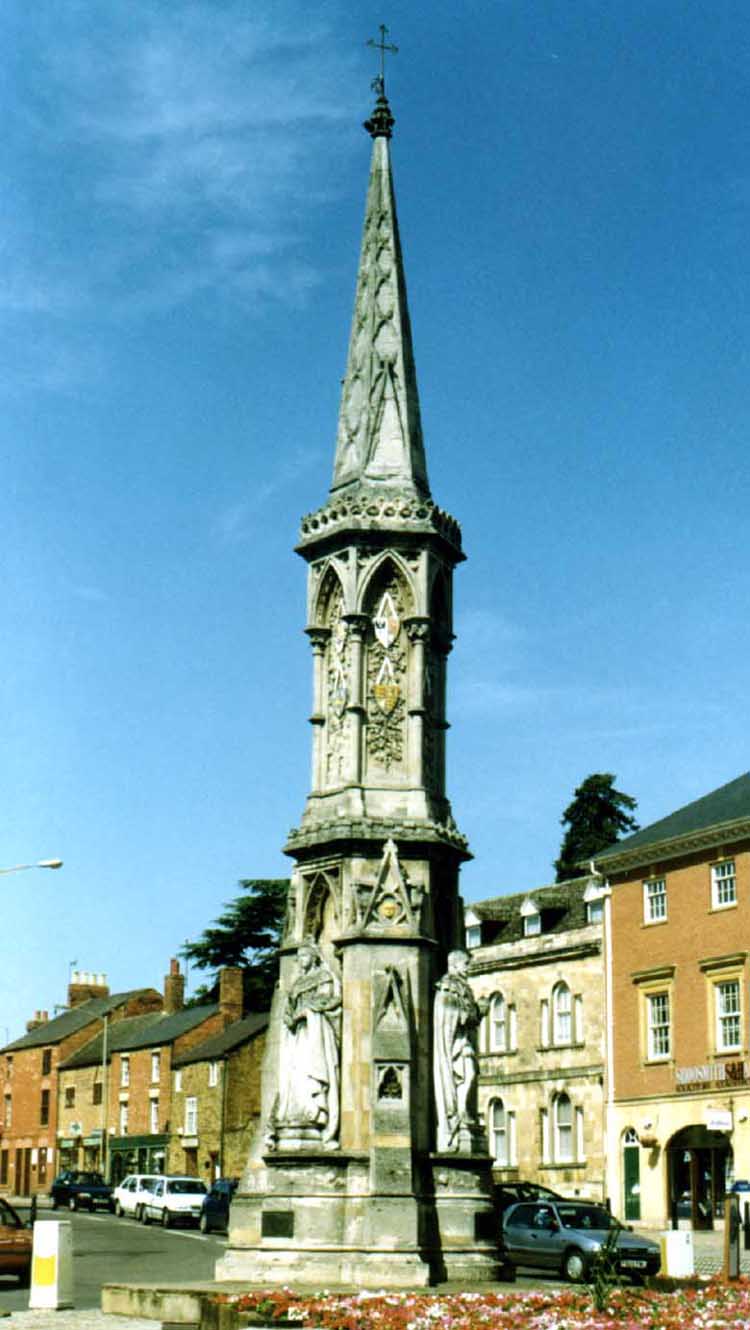
Banbury Cross, England
Being British, some were constructed in a Celtic design, in wood or stone, but other forms of cross were also erected. In fact just about any 'marker' has been used - cross, obelisk or spire - from little more than a pile of boulders to an elaborately built structure, like the world-famous Banbury Cross in Oxfordshire, pictured on the right.
The original stone High Cross was destroyed in 1600 by anti-Catholic Puritans who opposed the notion of pilgrimages. The current Cotswold stone cross is 16 metres high and was erected in 1859.
Such 'crosses' are often named after various saints or martyrs, or simply named after the place, such as Banbury.
Market day was traditionally Sunday, the day farmers did not labour, and the markets were held in church yards.
A parliamentary Act prohibited these markets in the 13th century and they moved to the town square. They were often run by monasteries, who charged a rental for the stall or site. The cross was erected to give a Christian presence to a market place and encourage honest trading. Most people would be self-sufficient in vegetables so market goods tended to be meat, fowl, and dairy produce like butter. Hence an alternative name: Butter Cross.
In Salisbury, Southern England, you can see a 15th century cross in the Market Place in the spot originally earmarked for trading in poultry, hence its name: Poultry Cross.

Poultry Cross
© Kaihsu Tai
(Click to enlarge)
About 50 km to the east is Winchester and when the plague hit in the Middle Ages, to avoid exposure to afflicted victims, merchants left produce at the foot of the market cross in the morning and returned in the evening to recover the unsold goods and the payment. The coins were steeped vinegar as a disinfectant. (See Winchester Cross)
In some cases, as the community grew, the Market Cross was often in the way. If they were in bad repair they were simply demolished. Others, like Hunts Cross, were moved to a more convenient location - perhaps a park or local parish church grounds (see Churchyard Cross.)
Whilst many of the actual crosses have disappeared, through natural weathering or blocks of stone 'borrowed' to repair buildings, many stumps remain (see top of this page) and show quite clearly the traditional plinth of three steps. (See Calvary Cross)
Some places incorporate 'Cross' in the name, not because of a particular structure or monument, but because the village lies on a major crossroads. Barcombe Cross in Sussex, England, is one such example. It's the site of a Roman-times settlement at the junction of the ancient Greensand Way and the main London-Lewes road. Bridgeton Cross is another example.
Mercat Cross

Mercat Cross, Aberdeen

Village Cross, Hungary
A Market Cross in Scotland is known as a Mercat Cross (meaning Merchant's Cross). Over one hundred of these can still be seen dotted around the country.
Village crosses are not restricted to Britain of course; they can be found all over the world, as with the beautiful example seen in the photo (right) from a small village in Hungary.
During the Protestant Revolt many Market Crosses were destroyed, but since then, in the more tolerant and enlightened years, a great many towns and cities have been restoring the crosses so wantonly ruined in fits of anti-Catholic political fury.
Why you should ride a cock horse to Banbury Cross
Why anyone would want to see such a lady is a mystery, but first, they'd have to acquire a cock horse (spirited horse or stallion).
Here's the story of a pastor who had such a spirited horse; spirited in the sense that he'd trained the horse to obey instructions through spiritual words and phrases. He was selling the horse and one day a man showed interest and came to look the horse over.
He wanted to have a test ride, and the pastor agreed. He told the man if he wanted the horse to trot, he just had to say "Praise God" and if he wanted the horse to stop then all he had to say was "Hallelujah!"
So the man mounted the horse and said "Praise God" and the horse started walking. But the man wanted to go faster, so he said "Praise God" again and again until the horse was galloping at a speed of his liking. He then saw a cliff edge coming up real fast and he needed to stop. But he forgot what he had to say to stop the horse.
Then just before the edge of the cliff he remembered, and shouted "Hallelujah!" The horse stopped. He let out a sigh of relief and said "Praise God"...
... and the horse walked off the cliff.


