St. Hans's Cross

The Scandinavian and north European name Hans (or Hannes) is shortened from Johannes, the Proto-Germanic form of John. This cross is named St. Hans's Cross after St. John the Baptist and known in Heraldry as the Bowen Cross. An ancient Scandinavian design such as this is often called a Shieldknot.
John the Baptist
John was a priest in the 1st century, Jewish, but regarded as a prophet by Islam (Surah 3:39) and the Bahá'í Faith, as well as Christianity. Christians often refer to him as 'John the Baptist', 'the Forerunner' or 'the Precursor' of Jesus Christ.
John's ministry is recorded in several parts of the Bible. Most notably, the time when he recognized Jesus as the Messiah and baptized Him. This marked the beginning of the ministry of Jesus, who had a special love and respect for John. Such was the power of John's teaching that people from all walks of life clamoured to hear him preach. He baptized those who wished so, and from this he became known as John the Baptist.
Around the same time, the son of Herod the Great, Herod Antipas, married Herodias. Now, Herodias had been the wife of his brother, Philip, and John condemned this as immoral. John made his displeasure known to Herod Antipas, who responded by imprisoning John.
One day, Herodias' daughter, Salome (of the dance of the seven veils fame) so much delighted Herod with a dance that he promised her anything she demanded. What she demanded, prompted by her mother, was the beheading of John the Baptist. After the execution, John's disciples interred his body.
Much later, in the 4th century, some of John's bones are reputed to have been taken to an abbot of Jerusalem named Philip. (From this, St. John became the patron saint of the Knights Hospitaller of Jerusalem.) His head is believed to be enshrined in Rome.
Birth date
John's birth is calculated to have been on about 24 June and this is his Feast Day. Most Feast Days of saints are held on the anniversary of their death, for example St. Valentine, so to recognize a saint on the anniversary of a birth day is unusual. Saint John the Baptist was unusual
His birth date is based on the Gospel of Luke's indication that John was born six months before Jesus. The birth of Jesus is celebrated on 25 December but there's nothing certain about these dates. Indeed, there is no historical evidence to prove which month or season Jesus was born in. Or even the year. But after many years of contemplation and argument, in the 4th century the date of Christmas, and consequently St. John's Day, were assigned. And since the 'why' is more important than the 'when', those dates have been good enough for Christians ever since.
Other people named after John the Baptist
There are a dozen other saints called John, and one from the 9th century, St. John of Tuy, shares the same Feast Day of 24 June. Another, St. John of the Cross, was born on 24 June 1542. It is not known, but there is quite a possibility that his parents named him John because he was born on the Feast day of John the Baptist.
Such a custom continues to this day - for example, John Illsley, bassist and founding member of Dire Straits, was born on 24 June and his parents named him after St. John.
Why this symbol?
In Scandinavia, Midsommarafton (Swedish: Mid-summer's Eve) or Sankt Hans aften (Danish: St. John's Eve), has long been considered the greatest festival of the year. It began as a Pagan festival long before Christianity entered the scene. Try as they did, the early Christian leaders couldn't prevent people enjoying themselves and the traditional Pagan festivities remained.
In Denmark, shoots of new plants emerging from the soil at that time were considered to have magical properties. Healers gathered these to supplement other herbs in their medicine boxes.

Midsommarstang Cross - a Swedish maypole
Huge bonfires were lit to burn witches and ward off evil spirits. Around the 10th century, the waters of certain wells were thought to contain healing powers on the Summer Solstice. Many of the Pagan fertility rites are connected with flowing water and the St. Hans Cross symbol represents flowing water. Another tradition is maypole dancing, which creates a swirling pattern like flowing water.
There is clear phallic fertility symbolism in the design of the Swedish Midsommarstang (maypole) made from birch branches, decorated in leaves and flowers, and often adorned with a pair of flower wreaths on the horizontal beam. (See also the similar Cana Cross)
In the Northern Hemisphere 24 June was the longest day of the year on the Julian calendar and the start of summer. Earth's orbit of the sun is not so precise and days shift forward a bit, so in 1582 Pope Gregory XIII introduced the Gregorian calendar which brought the Summer Solstice to 21 June. Nevertheless, 24 June was still considered the day for midsummer celebrations and consequently there was a time-connection between the Feast of St. John and Summer Solstice (just as Jesus' nativity connects with the Winter Solstice at Christmas time).
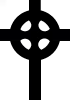


In Western Europe and Anglocentric regions, St. John has been ascribed to the ancient British Celtic Cross. Similarly, in Northern Europe, St. Hans been ascribed to the ancient Norse Shieldknot. A Shieldknot is any form of knotted and intertwined design representing the notion that every action has a reaction, that everything in this world is intertwined, and that its course depends on 'fate'. Shieldknots, like Celtic Swirls appear in so-called Kabbalistic magic. See also King Solomon's Knot
With a bit of imagination, the continuous loop of the Hans Cross could be viewed as four distinct Shepherd Crooks, set at right-angles.
Heraldry
In heraldry, the symbol is known as a Bowen Cross.

'National Heritage' road sign
A similar symbol is also seen extensively today in Northern Europe as a road sign to mark National Heritage and other places of interest. These include pre-historic sites, old ruins, museums and many other sites ruined by weather or wars in the past, and ruined further by the presence of souvenir shops in the present.
As mentioned above, the St. Hans Cross is meant to represent a continuous flowing and it is similar to the infinity symbol.

The address of the world headquarters for computer giant Apple Inc. in California is 'One Infinite Loop'. Coincidentally, in 1984, a command key on Macintosh computers was manufactured with the St. Hans Cross design.

Not to be outdone, Microsoft introduced a similar symbol for their Office logo.
Plus the relatively small faith in Iraq and Iran known as Mandaeanism, where Jesus is acknowledged to have lived but is not the Messiah. They consider John to be the only true Messiah.
See also Matt. 11:9
John 3:30
Matt. 3:13-15
Matt. 11:11
Mark 1:1-4
Matt. 14:3-12
The change was not universally adopted. The Russian team arrived 12 days late for the 1908 London Olympics because they were still using the Julian calendar. ('1,339 QI Facts To Make Your Jaw Drop' by John Lloyd, John Mitchinson & James Harkin: Faber & Faber)


