The Cross
an emblem of Christianity

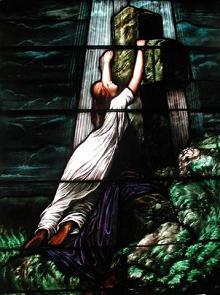
Rather than worshipping the cross per se, this woman is shipwrecked and clings to the cross to be saved from drowning in the stormy sea. This popular 19th century art reminds us that in the storm of life, we just need to reach out for salvation.
God-fearing Christians believe that Jesus accepted crucifixion on a cross for the benefit of us all. The message from this is at the heart of all true Gospel preaching and consequently the cross symbol is used by two billion Christians all over the world.
This has not always been the case however. Christians didn’t use the sign of the cross as their religious symbol for many generations after Christ was crucified. Rather than being a Christian symbol of hope and love, it only had the negative association as an execution apparatus for criminals.
So initially, Christians adopted the  trident symbol or the
  fish symbol to identify their religion. Then, early in the 4th century, when Emperor Constantine publicly declared that Christianity should be tolerated, execution by crucifixion was abolished and the cross became the emblem for Christians.
The cross is now carried by more people than any other religious talisman and is considered by a few to be sacred to the extent that it becomes icon of adoration in its own right. However, such idolatry is certainly not the norm in Christendom, particularly Protestant Christianity.
In heraldry crosses are grouped into the following main categories:
| ✝ | crux immissa |
| T | crux commissa |
| ❘ | crux simplex |
| X | crux decussata |
The former (✝) is often depicted as the type used to crucify Jesus, although we don't know for certain what the True Cross looked like.
Theologians and historians have long debated which type of cross was used for the execution. But whatever it was, the style doesn't matter as much as the meaning of the Cross.
Crux Immissa (✝)
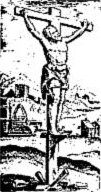
Crux immissa
Drawing by Justus Lipsius
(1547 - 1606)
The Crux Immissa has a Patibulum (horizontal beam) inserted at right-angles to the upright post. Immissa means 'inserted', and this is the more common form of the Christian cross.
Another name for this cross is Crux Capitata, which means 'with a head'.
(more...)
Crux Commissa (T)
The Crux Commissa is a 'T' shaped cross; commissa meaning 'joined' or 'attached'. The more widely known names are the Tau Cross (St. Anthony's Cross) and the Forked Cross (Y-shaped Cross).
(more...)
Crux Simplex (❘)

Crux simplex
Drawing by Justus Lipsius
(1547 - 1606)
The Crux Simplex or Stipe, being a simple upright post, does not have the transverse beam found on other forms. The ancient Greek word for stake is stauros (n) and stauroo (v).
This simple post was common for crucifixions until the Phoenicians added a cross beam.
(more...)
Crux Decussata (X)
Crux Decussata comes from decus, Latin for 'distinction', 'honour', 'glory' and 'grace'.
The Roman numeral 'X' has a value of ten and is associated with 'completeness'.
(more...)
Note that Constantine introduced "official toleration" of Christianity. Contrary to popular belief, he did not make Christianity the Roman Empire's "official religion". That took place nearly a century later during the reign of Theodosius.
Rock of Ages and The Old Rugged Cross. See also Psalm 68-69
See the Meaning of the Cross