Wedding Cross
also known as Cana or Marriage Cross

All crosses have deep symbolism, and the Wedding Cross is no exception. It is one of several Christian Crosses with a romantic message. (See Romantic Crosses)


(Click photo to enlarge)
The Wedding Cross features two interlocking wedding rings. The rings may be below the horizontal bar of the cross, on the bar, or above it, as shown in the Chi-Rho version on the right, stamped on some leather coasters.
Two interlocking rings on a cross form a composite symbol of commitment of a couple to live, love and grow united together in God's grace. It symbolises the partnership of the husband and wife with Christ.
Such an item may be presented as a gift to the couple. It is also seen embroidered on the minister's stole or alter cloth, to remind us that the minister, whether he is a priest or an unordained lay pastor, the fundamental meaning is the same: All Christian denominations acknowledge that the minister merely officiates the marriage ritual, and it is only God who joins people together in marriage.
The rings and the cross remind us of that important point.

A further cross of interest has just one ring. Today in Western cultures at least, two wedding rings are common during a wedding, but that's only been the case for the past 100 years or so.
Long ago, the bride's ring symbolised ownership of the wife by the husband, so it was ridiculous for a man to wear a ring. Pragmatically, a ring could interfere with his manual labour, or even catch in machinery and cause injury. But all that changed during the First and Second World Wars, when soldiers went overseas to fight, fearing they would never return, they wore a ring to remind them of their wives.
The custom continues today, heavily supported by jewellery shops of course.
(In a religious context, although the circle is ubiquitous in Christianity, it also represents pre-Christian Pagan religions, where the Sun was worshipped. The symbol therefore could also be viewed as Christianity rising above the pre-Christian religions.)
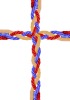
The image on the left is a Rope Cross and the rope is made from three strands, twisted together. Solomon illustrates the strength of the three-ply rope in Eccles. 4:12. Two strands are better than one, he explains, because they can support each other. And if a rope has a third strand, it is even stronger.
When two people are joined in love, if Christ is in their lives then like a three-ply cord, the marriage is strong.


