Swastika and Suavastika Crosses
- Bent Cross
- Buddhist Cross
- Crooked Cross
- Cross Gurgity
- Crux Gammata
- Fylfot
- Gamma Cross
- Gammadion Cross
- German Cross
- Hakaristi
- Hakenkreuz
- Hakenkruis
- Hooked Cross
- Khas
- Manji
- Nazi Cross
- Pērkonkrusts
- Rotating Cross
- Spinning Cross
- Suavastika
- Swastika
- Tetraskelion
- Wheel of the Dharma

Swastika

Suavastika
This is a religious symbol, also used in a secular context.
Being a cross, one of the religions using this symbol was Christianity in the Middle Ages and referred to as a Gammadion, a group of four Greek letter gamma (Γ), the capitalised third letter of the Greek alphabet. Three in a Christian context is a reminder of the Trinity, and each gamma represents one of the four Evangelists, who radiate from the central Greek Cross, which represents Christ.
Today it is perhaps best recognised as the 1930's emblem of Adolf Hitler's extreme-right Nationalsozialistische deutsche Arbeiter-Partei, commonly known as Nazi. During the Second World War the Swastika was often derisively called the Bent Cross or Crooked Cross a slur intended to show that Hitler, an outlaw, was using a Christian cross in a malevolent, non-Christian manner.
Orientation


More than enough has already been written about the swastika's use by the Nazis and we have no interest in writing much more; except to say that it is often confused by the Suavastika (or Sauvastika). The difference is the direction of rotation, for that is what this cross represents. It is a spinning or rotating cross, with the angled ends appearing like the sparks of a spinning fire-cracker. (In heraldry this would be classed a Cross Gurgity; from the Latin gurges, meaning 'spiral' or 'whirlpool'.)
The reason the cross spins, and its direction, depends on the various interpretations by the various users of this symbol (reincarnation, rotation of the stars, etc.) A suavastika shows its arms bent to the left (indicating clockwise rotation) and the swastika's arms bent right (anticlockwise).
Usually!
In fact, both symbols appear in either orientation; sometimes the suavastika's arms are bent right, and sometimes the swastika's arms are bent left.
Generally though, the arms are as shown above and we'll stay with that convention in these webpages. One marked difference is that the Nazis usually displayed their emblem at 45 degrees. It was then called the German Cross or Nazi Cross, and sometimes by its German name Hakenkreuz, from the Dutch Hakenkruis, meaning Hooked Cross.
The word "Swastika" is of Indian origin and even a girl's name in certain parts of India. Since it has a long history and profound meaning in India, perhaps we should restrict using the name to that Indian context, and use other names for other situations; Nazi, Gurgity, Manji, etc, as appropriate to avoid misunderstanding.
Oriental
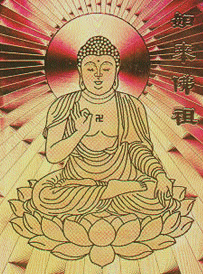
Image of Gautama Buddha...

with heart seal
Yes the swastika was, and still is, a symbol of Nazism, but its history goes back much further than 1930s. The emblem had been in use for thousands of years before Hitler decided it was a cute little symbol he could use to terrorise the world, especially Gypsies and Jews. It seems ironic that it was used by the Jews long before Hitler was born.
Secular groups include the Red Swastika Society, founded in China in 1922 on similar philanthropic principles to the Red Cross, with a large dose of Buddhism. Not restricted to China, the charity has conducted relief work in Japan and the former Soviet Union. Today the Society has branches in mainland China, Taiwan, Hong Kong, Singapore and Japan.
Much earlier, it was used by the Ashanti in West Africa, far removed from the Adolf's 'master' white race. The symbols are found in remains from the European Bronze Age, especially at Hissarlik (Troy). It has been found in ancient Jewish synagogues, used by the Basques, French, Greeks, Swiss and Irish, the Tlingit of Alaska and the Cuna in Panama.

Indian flag of Jainism

Kuna, Panama & Colombia
It is found in China, Mongolia, Tibet, Japan, ancient Persia, Pakistan, and in India, where both Jains and Buddhists still use it as a religious symbol.
The Mexicans, Aztecs and Indian tribes of Central and South America have used it (for example the Kuna; the indigenous people of Panama and Colombia), as have the Navajo, Sioux and Hopi tribes of the north.
In fact just about everywhere except Germany! Maybe Hitler adopted it out of jealousy.
Ornamental
A related symbol is the Triskele and as with all symbols, any adoration or abhorrence is because of what the swastika represents rather than the mere ornamental arrangement of a few lines. In the West, the sign still enrages people, as Britain's Prince Harry found out. Nobody knows for certain why he wore it - a curious choice for a former British Army commander who was third in the line of succession to the throne - just as nobody knows for certain why Hitler adopted it.
Some people might wear the symbol as decoration, in the form of a tattoo or lapel pin badge. Their intentions are probably as varied as the number of people who wear them; as a superstitious charm or amulet against evil, a 'good luck' charm or just a desire to look tough.
But in religion, its meanings are quite clear:
Buddhists
Resignation, the Wheel Of The Law and also a Heart Seal symbol stamped on Buddha's heart. Some monks often have this symbol placed on their chest when they die.

at Nasu
at ShibamataThe Suavastika Cross, also known as a Buddhist Cross, is frequently seen on temple gates and entrances, and used as a general-purpose identifier on maps and so on.
In Japan, the symbol is called Manji. There are several websites about Buddhism in Japan, but sadly most are in the Japanese language. However, we've been alerted to a very clear and well-informed site called japanese-buddhism.com, which includes more about the swastika in Japan, in English.
During World War II, Japan was an ally of Germany but never used the symbol in the same way as the Nazis. It is a Buddhist symbol and if there was any religious fervour behind the Japanese military power, it was Shintoism rather than Buddhism.
The symbol can be seen all over Japan today and was probably more ubiquitous 80 years ago than in Nazi Germany. The upper photo on the right is an ancient stone spotted at the road side near a temple in Nasu. (Click image to enlarge)
The lower photo is a more recent cross with a Kosodate Jizo statue at Shibamata station, Tokyo. It's one of the few railway stations in the world with a cross
Hindus
In sanskrit, the primary liturgical language of Hinduism, the name of this symbol in a clockwise orientation is स्वस्तिक, pronounced swastika. (Sanskrit: su = auspicious, astika = to be). It symbolizes the sun (सूर्य "surya"), prosperity, good fortune and blessing. The swastika represents Nirvritti, introspection and the involution of the universe, and the bliss, delight and peace of Nirvana.
In an anticlockwise orientation the symbol is called sauvastika, symbolizing night, magic, and the goddess काली (Kali) who destroys evil forces. It also represents ब्रह्मा (Brahma), the god of creation.
The suavastika is also a symbol for Parivritti (with variations on the English spelling), a revolved side angle pose in yoga (from the Sanskrit: para = beyond, vritti = vortex).
Jains
The Jains' seventh saint, the Jaina four-footed cross croix cramponnée and the four levels of existence.
Sioux
Pre-Columbian peoples of Lakota, Dakota and Nakota used the symbol (in both directions) woven into blankets and rugs, not only for day to day use, but also to embellish various forms of religious shields, and shields carried into battle. The symbol greeted the Sun at dawn and was employed in rituals and dances as a "living icon" of the Creator. Being by far the brightest of all visible entities in the cosmos, the Sun has for millennia been regarded as a deity or a symbol of God for many cultures and religions.
After the Europeans colonised and established government of the continent, subjugative and suppressive laws were passed in an attempt to assimilate indigenous cultures into European culture. The Sun Dance was one of several prohibited ceremonies in the US until the 1978 American Indian Religious Freedom Act (AIRFA), giving a little more credibility to "land of the free and the home of the brave".

Click to enlargeFor the symbol itself, several Indigenous Nations renounced it during and after WWII, quite likely following substantial government coercion.
Whatever caused compliance then, Siouans are now more aware that Nazism was and is completely unrelated to them. Further, the shunning of their sacred symbol can be seen not only as an extension of cultural colonisation, but also as a method of spiritual colonisation.
To reclaim their identity and God-given right, they are now in the process of reclaiming their symbol, over-riding Jewish opposition.
Pagans
In Scandinavia, it was the symbol of the hammer of the god Thor. In Latvia and Lithuania, the name of this cross is Pērkonkrusts, which means 'Cross of Thunder', Pērkon being their equivalent of Thor.
Project Runeberg shows this also has been a symbol in Finland (on Air Force Command ensignia until 2017), called Hakaristi, and based on an ancient sea god named Tursas. The swastika shape is central to the symbol representing the heart of Tursas and called Tursaansydän.
Christians
As a pre-Christian, Roman pagan symbol, it represented the four classical elements, four directions, and the recycling of life and death. By extension this meant life, regeneration, resurrection and everlasting life.
The symbol appeared on Roman coins and tombs. Early Christians carved it on their tombs as a symbol of everlasting life. It wasn't until the 4th century, when Christianity became the state religion of the Roman Empire, that Christians started to use the Latin Cross as a tomb sign for everlasting life. Today, fylfots are sometimes seen as decoration in medieval church architecture such as stained-glass windows.
As mentioned above, it represents a group of four Greek letter gamma (Γ), the capitalised third letter of the Greek alphabet. In a Christian context, 'three' is a reminder of the Trinity, and each gamma represents one of the four Evangelists, who radiate from the central Greek Cross, which represents Christ.
Masons
The Mystic Cross founded by Fohi 3,000 years ago, the first King of China, who some say is the same person as Noah. But as with the origin of many ancient symbols, textual evidence is sparse and scholars must conjecture what they can from the surviving artefacts.
Occultists
A sacred symbol. One theory goes that Karl Haushofer, the university professor of Rudolf Hess, was an occultist and introduced the symbol to Hitler.
Falun Gong
The Wheel of the Dharma.
Esoteric philosophers
A mystical and ancient symbol. (See Kabbalah Cross)
Raelians
The Raelians are a group that thrives on controversy and is a relatively new user of the symbol

The above describes the oriental and ornamental uses of the cross. Finally, we introduce the...
...illegal
In some countries (such as Germany and Austria), displaying the symbol is illegal because of its links to fascism. In other countries (such as China), current users (Falun Gong) are themselves illegal.
The symbol means love or hate, life or death (or both), suspicion and benign acceptance, black magic and God.
Has there ever been a more diversely used symbol than this?

Current
Golden Dawn

1980's
Golden Dawn

Ancient Greek Meander
The small but dangerous Greek ultranationalist Golden Dawn have adopted a similar symbol.
They say it is really a meander – a claim which reminds us that a symbol represents whatever we want it to represent.
National Socialist German Workers' Party
'Crooked Cross' is the English translation of the German name of his cross: 'Hakenkreuz'
British author Rudyard Kipling, who was born and raised in India, published his books with an embossed symbol on the cover: a suavastika inside a circle. According to Kipling, this was an ancient Sanskrit good-luck symbol. After Kipling's death, the circled suavastika continued to be printed on editions of his books - until World War Two, when the symbol was removed because it resembled the Nazi swastika.
For the Fish-Hook Cross, see Moline Cross
In Mongolia, this rotating cross has spun back into the modern era by being adopted by the xenophobic Tsagaan Khas (White Swastika), a small but violent neo-Nazi organisation.
We don't really care why Hitler adopted it, but one of many theories is that the angled swastika emphasizes overlapping 'S' letters, also seen in the Schutzstaffel (SS) insignia. Or vice versa; we really don't care.
- Cross myself for good luck
- Lucky Seven
- Lucky Cross
- Relic Cross
- Sanskrit good-luck symbol (Suavastika)
- Seven lucky Japanese gods (Shichifukujin)
- Pagan customs
- Lucky days for weddings (Rokuyo)
- Isn't religion simply glorified superstition?
- Wedding superstitions
- Lucky talisman
- Lucky Four-leaf clover
- Lucky Horseshoe
- Good luck - Fingers crossed
Project Runeberg: runeberg.org:80/...


