Sun Cross
Also known as a Pagan Cross, Solar Cross, Wheel Cross, Odin's Cross or Woden's Cross, Dyeus Cross, Zeus Cross, Tengri Cross, etc.

The Sun Cross features a circle around a cross. Whether or not the ancients realised that the sun was spherical, a two-dimensional circle is a natural choice to depict the sun. But for its cross, we need a little bit more imagination.

Fire bow
Before religions developed, primitive man had already worked out a way to make fire. The fire bow was one of the apparatus used and it would be natural to adopt the cross symbol to represent fire. Since the sun looks fiery and gives both warmth and light, the cross was a suitable enhancement of the circle to distinguish it from the full moon and other planets.
The Sun Cross is an ancient symbol; carvings of which were found in 1980 on the bases of Bronze-age burial urns at Southworth Hall Barrow, Croft, Cheshire, England. These urns date back to circa 1440 BC and the symbol has been used throughout history by different religions, groups and families.
Different cultures have had their own names for their sky or sun deity, which unsurprisingly have been associated with the same symbol. Hence this is also called a Dyeus Cross, Zeus Cross, Tengri Cross, etc., which all represent the same magnificent ball of light in the sky that provides heat and light, enabling things to grow. Only later did man reason that there were more things to life than just heat and light, and realised there must be an even greater God who had made all this possible. And why.
Given its extensive use as a representation of God, it is not surprising that this symbol has worked its way into Christian iconography.
Cosmic
Calling it a Solar Cross or Cosmic Cross focuses on the four divisions within the circle representing the four seasons and marked by the solstices. It is also said by some Neopagans to represent the four directions: north, south, east and west - although what that means in the context of an infinitely large cosmos is unclear.
The symbol is just so old and so simple, it's unrealistic to believe that there's just one interpretation. It's a godsend to self-styled wizards to make up whatever they want to say about it.

Crop circle
As a pagan or mystical symbol, there was a small resurgence of interest after the proliferation of similarly patterned crop circles which confounded 'cerealogists' in the 1970s and 1980s. On 12 August 1989 this crop circle was sighted at Winterbourne Stoke, Wiltshire in southern England.
No doubt there would have been a rush (!) on Brighid Crosses at that time. For most cerealogists, it was the final (wheat) straw when in 1991, local artists Doug Bower and Dave Chorley admitted their wheat graffiti was a hoax to fool UFOlogists.
The sun is a preserver of life; unless you happen to be stuck in the desert of course. As controller of the actions of planets and their moons, no one doubts its power and has for a long time been considered by mankind to be generally a good thing. So good, in fact, that it's been worshipped as a god for thousands of years. It was named by the ancient Egyptians, Ra.
Ra

To some people the sun was Ra, to others the sun was just Ra's eye. Consequently Ra was symbolised as either a circle, or a circle with a central dot for the iris. The sun has been symbolised in several other forms, some of which have included rays (just a coincidence that Ra is pronounced ray). And these rays sometimes give the appearance of spokes, making the symbol look like a wheel with its hub being the iris.
(A circle with a centre dot was also used to symbolise gold in alchemy; gold being the most precious metal and therefore associated with the greatest god, Sun.)
Ra was the main god in the ancient Egyptian city of Heliopolis, but from c. 2400 BC, he became a national deity. Around a thousand years later, Ra was combined with the god Amen. The reasons for this merger are unknown, but we can speculate that the Egyptians felt there could be only one supreme god, and combining Ra (the god of light) and Amen (the hidden god where there was no light) gave Egyptians the monotheism they sought.
Taranis

The Taranis symbol is neither a cross nor a representation of the sun, but some people refer to this as a Sun Cross.
Wheels appear in crosses more often than we might think. See for example the Bezel Cross and the Dharma Cross.
Woden's Cross / Odin's Cross
And here's another wheel that people mistake to be a cross. Like Taranis, Woden was not supposed to represent the sun. Woden was a bit of a trouble-maker...
Neo-Nazi Cross
Apart from Woden, other trouble-makers who use this symbol include the Ku Klux Klan and the Ratniks.
Kutsuwa-mon (Kamon)
In Japan ka means 'family', mon means 'crest' and this symbol is one such family crest. Like European heraldry, kamon were used especially in battle to identify individuals or members of a clan.
Cardinal Cross
Cardinal Cross
Confusingly the Sun Cross, the cross within a circle, is also the Planetary Symbol for the earth. (See also World and Cross).
The same pattern (or any cross design) is sometimes referred to as a Cardinal Cross. Since the 16th century, 'north, south, east and west' have been called 'Cardinal Points'; cardinal meaning something that is fundamentally important.
This description has evolved into a wider use in astrology (Aries, Cancer, Libra and Capricorn), taking people's thought into a different dimension than simply north, south, east and west. This Astrological Cross (or Aquarian Cross) divides life into four identities: self, emotional, intellectual and the actual manifestation of the identity.
'Cardinal' in this context describes its important responsibility in 'turning' the cosmos, just as a hinge is essential for a door to open. Within the Roman Catholic Church are some essential people, specially elected principals to direct the Church who, since the 12th century have been called Cardinals. (See the Cardinal Cross for the symbol usually associated with Roman Catholic cardinals.)
Christian Cross

In Estonia, this cross has been found in Christian graveyards (see Vormsi Cross).
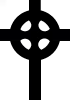
In the Christian Church generally, this cross design is known as the Consecration Cross. The design varies from being a cross within a circle, shown on the left, to something similar to a St. John's Cross.
The Consecration Cross, like the sun, is circular. And it's not only the shape of this cross that makes Christianity appear to revere the sun. It's easy to understand why some people have written articles supporting their firm belief that Christianity is actually a Pagan form of sun worship.
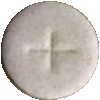
In Christian iconography, the sun and cross appear in the Celtic Cross, the Glory Cross, in halos and in communion wafers. And there's no escaping the similarity with the sun in the monstrance.


Monstrance
The sun is clearly seen on the banner of the evangelical Christian organisation, the Salvation Army. It repeats itself in the construction of church buildings, and images of the Virgin Mary often show her heart, or baby Jesus, radiating like the sun. For the Roman Catholic 'Society of Jesus' (Order of Jesuits), the sun is central to their symbol.

Salvation Army flag

Church dome

Mary's love
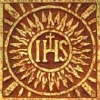
Jesuit symbol
And to 'prove' Christians are really Sun-worshippers, let's remember what day of the week Christians reserve for their Lord!
Of course, we are not supporting this Sun-worshipping view. But if it's not Sun worship, then why do Christians use the sun symbol so much? The answer is simple:
Firstly, the halos and sun rays depict glory. How else are artists to depict the brilliance of glory, if not by reproducing the strongest physical light known? Secondly, the sun gives light and warmth. Both light and warmth are considered by humans to be good. And finally, the circle is considered by humans to be a nice shape.

Consider for example, the food bowl and the dinner plate. They both give us a positive feeling. Rounding off rough edges seems cleaner. Roundness is a natural shape. Roundness is somehow an aesthetically pleasing shape.
Contrast that with the jagged and terrifying shape of lightning. Consider the Nazi Schutzstaffel (SS) insignia incorporated into the Kiss logo. The pointed teeth of vampires are not so comforting, and we can even enhance the horror by choosing more pointy letters when we spell it as 'vampyres' (similarly 'wytches', 'magick', etc.). The jagged dagger and crooked witch hat seem somewhat more sinister and menacing than a straight dagger or hat. Straightness and roundness is nice for us. Crookedness is not.

Zzzappp!

Some people actually like this stuff

Daggers

Witch hats

'Baphomet'
Compare images of Jesus' rounded face, beard, halo and fluffy clouds, with the Devil's pointed face, beard, horns, spiky tail and pitchfork. God only knows what Satan looks like, so we make images based on our imagination, such as the goat figure Baphomet.
The meaning of the sun symbol in Christianity
Yes, circles feature a lot in Christian images, but the circle is a common and popular shape in many art forms, not necessarily depicting the sun. We see lots of straight lines in Christianity too. If we look at the sun image as just a bright circle, then we can easily debunk some of the Christian Sun-worshipping ideas.
See Page 2 - Sun-worshipping debunked.
See also Glory Cross, Flaming Cross, Rising Sun Cross and the Star Cross.
Interestingly there is an etymological connection between "spell", as used by witchcraft to cause harm, and as used to select and arrange letters to make a word.
The old meaning of "spell" was to tell a story. A malevolent story was to cause harm to the person listening. Bad news.
Conversely, good news, a good story, is how we get the word "Gospel".
Jacob Grimm also had a good idea what Satan looked like.


