Communion Cross
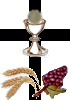
For Christians, the Communion Cross is a symbol of the freely-made decision to love and serve God
The Communion Cross is also known as the Eucharist Cross and several other terms. The version shown here is decorated with wheat and grapes, and a chalice. The cup is often shown in religious art in the centre of a cross because when the Roman soldier pierced the torso of Jesus with a lance blood and water flowed from this wound.
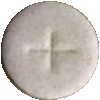
The term Communion Cross could also be applied to a cross embossed on a communion bread wafer. (See also Sun Cross)
During the Last Supper, Jesus instructed his disciples to fulfil a rite in memory of Him. There are many interpretations of what this means for Christians today, and how the rite should be observed. But the elements are mostly the same: a chalice, bread (leavened or unleavened) - the body of Christ, and wine - the blood of Christ.

Church of North India logo, featuring a chalice, consecration cross, lotus & circle

Christian Church (Disciples of Christ) disciples.org logo shows a chalice and Portate Cross

International Church of the Foursquare Gospel logo, featuring a chalice, cross, crown & dove
For many baptised Christians, the First Communion is celebrated at the age of seven or eight. At that time, a Communion Cross is often given as a special memento to the child. That is the age most children are considered to have reached the 'Age of Reason' and mentally capable of understanding the importance of the event and have a desire to participate.
This raises the obvious question about people whose mental faculties have not developed sufficiently to make such reasoning or have some profound retardation. The Church is clear in its responsibility in this case: inclusion. However, if a person has reached the Age of Reason and decides not to receive communion, that is their right and the Church respects this.
Priests and parents have a responsibility to encourage and guide children; without, of course, abusing their authority with coercion that seriously risks leading to resentment and ultimate rejection of Christianity later in life. A fundamental tenet of Christianity is that people have freedom, just as God gives us the freedom to love and serve Him, or not. Communion is a way for Christians to demonstrate their choice to love and serve God.
And this must be supplemental to actually practicing love for other people. Jesus said, 'Love the Lord thy God with all your heart, with all your soul, and with all your mind. This is the first and greatest commandment. And the second commandment is similar: love your neighbour as you love yourself.
If we truly love God, loving our neighbour is a natural consequence. Our responsibility doesn't stop at simply displaying a pretty Communion Cross or taking part in a rite.
Various terms are used by different groups to refer to essentially the same rite, including: Breaking of Bread, (Holy) Communion, Death and Resurrection of the Lord, Divine Liturgy, Divine Mysteries, Eucharist, Holy Mysteries, Holy of Holies, Holy Sacrifice of the Mass, Lord's Body, Lord's Supper, (Holy) Mass, Memorial of the Passion, (Blessed) Sacrament (of the Altar), Table of the Lord, and Thanksgiving.


