Anchor Cross
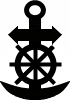
The Anchor Cross can take various forms and just a few are reproduced here:


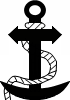


- Admiralty pattern (ca. 1550 – 1850)
- stockless (ancient design), similar to an inverted Tau or St. Peter's Cross
- comprising three crosses to represent the three crosses on Calvary or the Holy Trinity
- a hooked anchor, as seen with crossed swords in the coat of arms and flag of Vinnitsa city in Ukraine. The ω-shaped blades may be seen as a small omega.
- adorned with a rope which can also be viewed as a Serpent Cross
- adorned with a ship's navigational steering wheel; association with the Wheel Cross
- adorned with three tridents at the top, a heart in the centre and fish-tails at the base. This cross is the emblem of Saintes Maries de la Mer (see Camargue Cross)
- Croix Ancrée; a variation of the Moline Cross
- a variation of another marine implement, the trident, in this Tryzub Cross
- errr.... this is just an anchor. It has no religious significance except a pun on the word 'anchor'. In Greek it is called ankura, and the Greek phrase en kurio means 'in the Lord'.
It's hardly surprising we see the anchor in many church emblems; for example, National Association of Free Will Baptists (NAFWB), Salesian (Salesian), Uniting Reformed Church in Southern Africa (URCSA), and the wobbly one of the Boys' Brigade (BB).


The anchor is a life saver – it can prevent a ship from crashing on to rocks. For Christians, the analogy is that Christ can save spiritual lives. The nautical image of an anchor gives the idea of navigation (through life). Alternative names include St. Clement's Cross, Sailor's or Mariner's Cross.
Navigation Cross

Cross Staff
Another cross that helped early navigators was the cross staff, an instrument for measuring latitude. The staff was marked with a scale and fitted with a sliding cross-piece set at right-angles to the staff. With the tip at the navigator's eye, the cross-piece was slid up or down until its upper edge aligned up with the sun or polar star and the lower edge with the horizon. The reading on the staff was converted into degrees by referring to a table.
All much simpler to operate than today's GPS.
However, we landlubbers forget the obvious point that the anchor has nothing to do with navigation. On the contrary, the anchor stops you from going anywhere.

St. Ilarion Troitsky, a Russian New Hieromartyr, with a very nice Orthodox anchor cross on his vestments
It certainly stopped Clement, the fourth Pope, in the 1st century.

Vinnytsia city, Ukraine
Despite being over 400 km to the sea, the anchor and crossed sabers were granted in 1640 by Vladyslav IV

St. Petersburg, Russia
Sceptre with sea & river anchors representing the estuarial city's sea and river ports
Emperor Trajan banished him from Rome and forced him to work in the harsh Russian stone quarries. Clement caused trouble for himself by locating a spring of fresh water that could quench the prisoners' thirst. Whether or not the appearance of this spring was a miracle, we don't know for sure. But he was eventually made a saint so it's possible the church authorities later believed it was so.
In any case, the prison governor of the time was sufficiently peeved to order Clement's death. He was executed by being tossed into the Black Sea, before which he was tied to a heavy anchor to prevent rescue or recovery by other Christians.
The cross is therefore sometimes called St. Clement's Cross and Clement became the patron saint of anchorsmiths, blacksmiths, mariners, marble workers and stone cutters. (See Alexander Roman's fascinating article about the Anchor Cross and St. Clement.)
Clement was considered a renegade and ever since, the Anchor Cross has been used by Christians who have not wished to conform to the state religion.
When Christians have been persecuted and forced underground, their emblem has often been the Anchor Cross. To the outside world, it was just an anchor. To the Christians, it was a substitute Latin Cross. As with a ship's anchor, the Anchor Cross helped them to keep their faith firm in the stormy social and religious environment. They took comfort from the Epistle to the Heb. 6:19, which says: "We have this hope, a sure and steadfast anchor of the soul, a hope that enters the inner shrine behind the curtain."
This cross is also attributed to St. Nicholas of Myra, being the patron saint of seamen.
Although the anchor can be interpreted as an alternative to the cross, it is quite frequently seen together with a cross.

© reproduced with the kind permission of Amanda Norman Photography headstonesymbols.co.uk
(Click photo to enlarge)
The arrangement this photo, for example, is similar to that seen on a grave headstone, showing a cross, an anchor, and a heart. We know the grave is in the cemetery of a northern English town, famous for its textile industry, but we don't know anything about the deceased.
The symbols could represent anything we might wish to imagine; the anchor could mean the deceased had had nautical associations, the slanting cross could mean masonic connections, and the heart could even mean the deceased had suffered a heart attack. But we sincerely doubt any of those meanings were intended.
The slanting Portate Cross typically symbolises that the person had carried their cross through life, and now laid it to rest. The anchor and cross typically symbolises a steadfast attachment to the Cross and all that stands for. And the heart, of course, typically means love.
This beautiful collection therefore can symbolise the steadfast belief the deceased had in the Love of God.
See also St. Nicholas's Cross, Avellan Cross and a Stylised Anchor Cross.
Curiously, though based on Heb. 6:19 quotation "We have this hope as an anchor for the soul, sure and steadfast…", the anchor on the Boys' Brigade logo appears to be falling over.
More curious is that some of the original practices of the BB included rifle drills. The rifles were wooden replicas and the practice faded out around the time of WWI. Fortunately today, BB activities are more fun and meaningful.
But the toppling of their anchor remains a mystery.


