St. Andrew's Cross
also called a Saltire

He's said to have told his executioners that he was not worthy to be crucified on the same cross style as Jesus, and persuaded them to alter the shape. If this is true, it's a remarkable example of stoicism displayed by a man, no doubt beaten and starved, yet retaining the mental energy to plead such a thing with his brutal executioners.
Detailed records of Andrew's crucifixion only date back to the Middle Ages, and these records are influenced be the imagination of the medieval artists. But even if the origin is a myth, the cross shape reminds Christians that they should exercise humility.
In Greek, the first letter for Christ (Chi) also happens to be 'X'-shaped, as in the Chi Rho Cross.
See also similarly shaped crosses:
 |
an extreme example of the Auseklis symbol used as the Insignia of Latvijas Zemessardze | |
 |
the tri-parted Fretted Cross | |
 |
 |
crossed swords, in different directions and opposite meanings |
 |
 |
the non-Christian chigi, also with opposite meanings depending on the angle or each arm's tip |
 |
Katanga, Congo | |
 |
odal, a Nordic rune | |
 |
Burgundy Cross | |
 |
St. Patrick's Cross, an emblem of Ireland | |
 |
Logo of X Corp since 2023, a symbol familiar to mathematicians for decades earlier (𝕏 to distinguish between the letter X and the multiplication symbol). |
In an heraldic/non-religious context, this shape is known as a 'saltire'.
saltire (n.)
also saltier, c. 1400, sautour, an ordinary that resembles a St. Andrew's Cross on a shield or flag, consisting of a bend dexter and a bend sinister crossing each other, from Old French sautoir, sautour, literally "stirrup," and directly from Medieval Latin saltarium, noun use of neuter of Latin saltatorius "pertaining to leaping," from salire "to leap". The connection between stirrups and the diagonal cross is said to be the two deltoid shapes that comprise the cross.
Yet instead of simply saying that something is 'X-shaped' or 'saltire', the term 'St. Andrew's Cross' is used for several items that have absolutely nothing to do with St. Andrew or even religion.
For example, there's argiope kiyserlingi and the argiope mangal - a tiny, brightly striped spider found in the mangroves of Singapore. These are commonly known as 'St. Andrew's Spiders' because they hold their eight legs in pairs, forming an X shape. Then there's the hypericum hypericoides, a small shrub of the St. John's-wort family. Its flowers form a cross with four yellow petals and is known as 'St. Andrew's Cross'.

Confederate Flag
The saltire is seen on the USA's Confederate Flag, showing the Scottish lineage of many southerners. (It wasn't the official flag of the Confederate states, but is nevertheless widely referred to as the Confederate Flag.) On this flag the saltire is known as the Southern Cross.
The saltire is also seen on several national flags, particularly where there's a historical/cultural connection with St. Andrew.

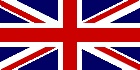

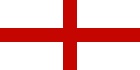
One of the best-known saltires is the flag of Scotland. This white cross on a blue background is called 'St. Andrew's Cross', St. Andrew being the patron saint of Scotland. A red cross on a white background is the St. Patrick's Cross, representing the patron saint of Ireland. Both of these crosses were superimposed on England's red cross on a white background, St. George's Cross, to give the United Kingdom's Union Flag ('Union Jack').


The St Andrew's Cross can be seen in civil logos, emblems and regional coats of arms.

Tenerife
In the Spanish Canary Islands, just off the Western Sahara coast, the 19th century masters of the island of Tenerife belonged to the Masonic Grand Lodge of Scotland. It's possible that they influenced the choice of the island's flag, albeit a slightly darker shade of blue. The blue represents the colour of the Atlantic Ocean and the white represents the winter snow-capped Mount Teide.
For the Scottish flag, the colours are said to come from a white cross made by clouds in the blue sky. In the 9th century, King Angus saw this arrangement on the day before a decisive battle over the English Northumbrian Angles commanded by Athelstan. King Angus considered it to be a good omen and won the battle. (See also Constantine's Cross.)
Merkill was the place where King Angus' army of Picts and Scots were fighting the King Athel's army of Sassenachs from Northumbria. One night, Angus prayed to God for help in the next day's battle. A vision of Saint Andrew appeared to him, promising victory. The next day, King Angus' men saw two long white clouds streaking across the blue sky forming a cross. They took this as a sign from Saint Andrew and were sufficiently roused to beat the lowlanders in the battle.
Of course, the sign could have been meant for King Athel's men, but perhaps they were too busy fighting to be looking up at the sky. Or were these long clouds the contrails (jet engine exhaust) from some early alien visitation?
Whatever interpretation we wish to make, the Scots believed it was nothing less than a miracle. This battle took place just a stone's throw from a village later known as Markle in East Lothian, Scotland. Markle village has now gone, but a few ruins remain (for example Markle Castle). The original name of the place was Merkill, and this might have come from the word miracle.
The white cross on blue background was adopted as the flag of Scotland and St. Andrew became Scotland's Patron Saint.


It is of no surprise therefore that the St. Andrew's Cross is the basis for many Scottish logos. In particular, the Church of Scotland emblem, which also depicts the miraculous burning bush that was not consumed (Exod. 3).
The burning bush symbol is repeated in the emblems of the Presbyterian Churches around the world and represents the bondage of the Church in Egypt. Their emblems remind us that the Church and the faithful, in every age and every culture, may suffer severe persecution. And yet God prevents his people from being destroyed.
A similar design is seen on the flag of Tallahassee, the capital of Florida, USA; and a variation of the St. Andrew's Cross is the Burgundy Cross. All these crosses represent the Christian religion of the kings and rulers at the time the flags and banners were made.
Other national flags have an 'X' cross, but these have no Christian basis.

Burundi
The flag of Burundi for example, where even though the country is nominally 'Christian', the white cross is not used as a religious symbol. Rather, it's a symbol of peace - the goal of everyone after years of ethnic violence between Hutu and Tutsi factions.

The flag of Grenada just happens to have a cross made by the four triangles of wisdom, warmth, vegetation and agriculture.

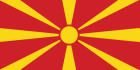
The yellow/gold cross on the Jamaican flag signifies sunshine, as with the Republic of North Macedonia's flag. (See also Macedonian Cross)

And of course Nova Scotia, whose name is Latin for "New Scotland"
Now for an old children's riddle:
Question: What's black and white and red all over?
Answer: A newspaper!
Without having to use the pun on 'read', we can see that Netherlanders seem to like black, white and red, and they've incorporated those colours into several regional flags with one or more saltires.

Ouder-Amstel

Amstelveen

Amsterdam

Breda

Hendrik-Ido-Ambacht
There are a few more similar Dutch flags on the Flag Index page, all of which incorporate one or more saltires.

Holland is famous for its windmills which can be easily recognised by their huge crosses.
Dr Van Helsing (Peter Cushing) took advantage of a windmill's cross to dispatch the creepy vampire in the 1960 Hammer movie The Brides of Dracula. (A 3½-minute video of the scene is here. And see the Dracula Cross, if you're interested in that sort of thing.)
As with the decline of the printed newspaper, the use of windmills declined during the Industrial Revolution and very few remain today. Some have been converted into museums, tourist information centres, craft shops and even homes, but we don't know of any that have been converted into churches or chapels. A few mock windmills have been built as wedding chapels, taking advantage of the romantic image of the windmill, and of course the huge blades that form a cross.

Vatican flag
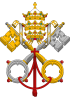
Finally, there's a variation of St. Andrew's cross on the flag of the Vatican (see also Papal Cross).
Since the 14th century, two crossed keys have been the official insignia of the Holy See. These keys are the symbols of St. Peter (popes are considered direct descendants of St. Peter's office).
The keys were given to Peter (see Matt. 16:19) by Christ to open the doors to paradise, just as the cross opens the gates of heaven for those who believe in Him.
(See other crosses on flags)
But what does the St. Andrew Cross mean for us today? See the meaning of the Cross and also read Humility and Sacrifice by Rev. David Linde.
Before Peter was crucified, he too requested that a cross different to Christ's St. Peter's Cross. Therefore we have another cross that Christians associate with humility; the upside-down Latin Cross, known as St. Peter's Cross.
An alternative name for Christmas is 'Xmas', a valid abbreviation although rejected by some as being a commercial attempt to remove Christ from Christmas, by crossing Him out.
To secularize the event even further, some might say "Happy Holidays", forgetting that the word "holiday" originates from "holy day".
(Curiously, Xmas is often written with an apostrophe in Japan as X'mas. See Christmas in Japan.)
The composition of the Union Flag is taught to British Boy Scouts as something that might be useful to know one day.
The burning bush symbol was also used by the early Huguenots
Please tell is you know of one!


