Cross and Crown

Crowns are often spiked, like rays of the Sun. This is no coincidence, since crowns have long been associated with power bestowed on the wearer by the ancient Sun god. Thus they are worn by royalty and those in supreme authority, and granted to those who deserve to wear them.
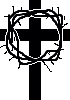
Cross & crown of thorns
Several parts of the Bible give promises of the ultimate crown to all who are worthy. Interestingly, the first reference in the Bible to 'thorns' is when God created them as punishment to Adam for his disobedience. In the Crucifixion, Christ accepted the crown of thorns as a symbol of sin and punishment to atone for our sins.
The crown of thorns was an attempt by the soldiers to mock Jesus, as they also did by placing a scarlet robe over him and a rod to hold as a sceptre. (See also Arms of Christ.) The crown of thorns also reminds us that whilst we might suffer on earth (bear our cross); the ultimate reward to those who believe in Christ will be eternal life in Heaven (our crown).

The cross is sometimes depicted at an angle (see Portate Cross), as it would have been when Jesus dragged it up the mound at Golgotha. The crown in this symbol can be in the normal wearing position (as in the image on the right), or up-ended (as in the image, above right) and similar to a wreath or the circle in a Celtic Cross. Whether the cross is adorned with a crown studded with jewels or a rough crown of thorns, the message is the same. (See Unique Crucifixion by Rev. David Linde).
For some Christian monks, it used to be common to shave the crown of the head leaving a circle of hair known as a tonsure. There were several reasons for this and one was to remind the wearer of the crown of thorns.
A relic of the crown believed to have been worn by Jesus is currently housed in Notre Dame, Paris, and has been identified as Zizyphus Spine Christi. This species of thorny bush still grows around Jerusalem.
In various religions, a skull cap (kippah, taqiyah, turban, etc.) may be worn as a mark of humility. For priests, as a mark of their temporal responsibility, headgear is almost invariably more distinctive and the mitre is a good example of this. In some churches, especially Eastern, the mitre of an archbishop takes the shape of a crown. This may be topped with a small standing cross of whatever style is associated with the denomination.
The crown symbolises the sovereignty of Christ and often feature on church emblems:
(Click any image
to enlarge)

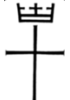


The cross and crown symbol is used by several churches; Baptist, Lutheran and Catholic, etc., but the symbol is not exclusively Christian. It is also used by the Freemasons, and from there became a logo for both the Christian Scientists and the Jehovah's Witnesses.
A related heraldic cross is the Engrailed Cross. See also the crown in the Claddagh Cross, the Military Cross and the Lutheran Cross of the Church of Sweden.
See also Salem Cross
The five-starred crown with cross is currently a trademark of The First Church of Christ, Scientist (Christian Science).
Their founder, Mary Baker Eddy, is reported to have had strong links with Freemasonry and married a Freemason.
Despite borrowing heavily from orthodox Christian imagery and vocabulary, Christian Science remains a significant distance away from orthodox Christianity.


