Budded Cross
also known as the Apostles' Cross, the Treflée, Botonée, Pelleted, Pommee, Beaded or Cathedral Cross
There's a huge variety of Budded Cross styles, all with slightly different meanings, to suit whatever purpose the church or other organisation wants to convey. Here are just a few of the dozens of different Budded Cross permutations:





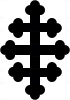
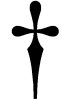
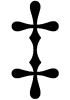


The Budded Cross may have a long stem or all the arms (or limbs, as sometimes called) may have the same length. There may be one bud or several. Typically there is just one cross beam, but multiple beams are not uncommon. The arm edges may be straight, convex or occasionally concave. Similarly the ends may be straight, convex or concave... and innumerable other variations.
The rounded bits at the arm ends may be spherical, rings, or solid discs.
The old Pagan use of the Celtic Cross is well known, where the circle or disc represented the sun. It is believed that design was copied by the Early Christians in Europe.
A cross with three circles or discs on each end in a Christian context represents the Holy Trinity but was probably also copied from earlier Celtic Druidry, where the circles or rings represent the three dominions of earth, sky and sea.
There are several names for this cross, depending on the interpretation. These include Budded, Apostles', or Cathedral Cross, all implying a religious theme, and Treflée or Botonée in a heraldic context.
In Abrahamic religious art, each arm may have one or more buds, three buds being the most common. Each arrangement can suggest different meanings:
One bud reminds us of Aaron's staff that budded (see Num. 17) and was preserved in the Ark of the Covenant, showing that life can emerge from death, and renewed life can emerge from difficult circumstances.
Or like the buds of a flower representing a journey of growth in faith; flowers growing but not yet in bloom.


Two buds make the cross arms look a bit like bones (see also Bones Cross).
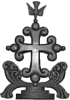
An example can be seen on the mitre in the emblem of the world's oldest national Church, the Armenian Apostolic Orthodox Church.
(Upper image - full emblem, Click image to enlarge)
(Lower image - close-up of mitre.)
Three buds reminds us of the teachings in 1 Cor. 13: "Faith, Hope, Love; The greatest of these is love."
Christians are also reminded of the Trinity by these three buds, or indeed anything else with a triple design, such as the three-leafed clover.
Since there are four arms, another name is the Apostles' Cross, with one bud for each of the twelve budding Christian apostles.

GOCC
(Click image to enlarge)Triple-budded ends feature on the cross in the coat of arms for the Greek Orthodox Church of Constantinople (GOCC).
A cross with three buds is often an identification mark on signboards and maps for a cathedral, hence it's occasionally named a Cathedral Cross. (Chapel and Church markers are usually less ornate, such as the Latin Cross.)
It's rare to see four buds on each arm, but these, and the four arms themselves, remind us of the four Evangelists.
Even less common are five buds. Very decorative, and five reminds us of the five wounds suffered by Christ on the cross. (See Passion Cross)


Other terms and styles

Vrnjačka Banja

Sumy Oblast
The terms Treflée Cross, Trefoil Cross, Botonée Cross or Bottony Cross are used more in heraldry than in a religious context. They are artistic variations of the Cross Crosslet and usually shown with all four arms the same length like the Greek Cross.
Examples are seen on these two Eastern European flags; Vrnjačka Banja in Serbia, and Sumy Oblast, Ukraine (Click image to enlarge)

The shape of the cross arm also has significance. The arm edges are usually either straight, to give more focus on the buds, or Pattée.

With larger discs, the cross may be referred to as a Pommee.
There's no standard to determine just how big each disc should be to qualify as a Pommee Cross, (similarly there's no requirement that all discs have the same diameter); just as there's no standard to determine how large a hill should be before it's called a mountain. But usually the discs are wider than the thickness of the cross arms.

The arms ends can be straight, concave, or convex, depending on whether the designer wishes to show the bud is 'attached' to the arm (as in the concave arm end) or 'leaving' the cross (as in the convex arm end).
See also the related Annulet, Nasrani, Nestorian, Obelisk, and the Fleur de Lis crosses.

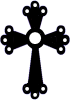

Botonéess is a heraldic term from the French bouton. English: 'button' or 'knob', with various spellings; Bottony and Botonee being the most common. Other spellings include Botonny, Botonnée and Botonné, using mixtures of single and double 't', 'n' and 'e' (with or without an acute).
A life of faith, hope and love is necessary to attain everlasting life in heaven.
When in heaven, our faith and hope will have served their purpose, since when the good things believed and hoped for come to fruition, the faith and hope ceases. Love will continue, but not in its earthly, human form. In Heaven, love will be made perfect and we will perfectly love God.

See also the 'lucky' Four-leaf Clover Cross
Synonymous with apostle is disciple. (See also the Consecration Cross.)
These apostles and disciples are followers of Christ and usually spelt with an initial capital letter when referring to one of the original twelve Disciples. Of course, discipleship is not restricted to those twelve men. In Matt. 16:24 we all have an invitation to be a disciple of Christ.
(For a warning regarding the so-called Disciples' Cross used in fund-raising campaigns, see Cross of Hope.)


