Invisible, Routed, Voided, Hollow, Optical illusion, Outline Cross
and introducing the Seiyaku Cross
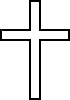
Closed

Open-ended
For Christians, the Voided Cross is a reminder that Christ rose from death on the Cross to proclaim victory over sin, death, and the Devil. So there is nothing 'void' about a Christian cross.
'Voided Cross' (Fr: Croix Vidée) is simply a heraldic term for when only the edge of the cross is traced. For example, a cross shape could be incised or carved in a rock or lump of wood.

A Voided Cross can be any shape or form. It could be a cross charged with a smaller cross of the same design, but having the same colour as the background – only the border of the larger cross is visible. Other terms include Rebated Cross, Recessed Cross, Sunken Cross, Fimbriated. Cross, Bordered Cross, Clechée Cross and Pierced Cross. (See also the Empty Cross.)

The Voided Cross and the Gamma Cross (shown on the left) have similar characteristics. The crosses have different names but they both say, albeit in different languages, the same Christian message, proclaiming of the Divinity of Jesus.
Gamma (Γ) is the third letter of the Greek alphabet, and three represents the Holy Trinity of God the Father, Christ the Son, and the Holy Spirit. This shows that Jesus Christ is part of the Godhead. Similarly the Voided Cross shows that Jesus Christ was resurrected and lives today in the Godhead.

© Franck Lemoine
(Click image to enlarge)
These photos show a nice cross with features that remind us of both the gamma and voided forms. On each budded arm end we can see two gamma characters, and the arms themselves are concave, showing the cross is now empty.
One could justifiably argue that the gamma characters are simply decorative angled recesses, and the concavature is an enhancement to the cross rather than an omission. But such arguments are a distraction from the more important belief of the Resurrection and Divinity of Christ.

Coticed
Cross
In heraldry, when the voided part of a cross is just a border within the cross, it is called a Coticed Cross (Fr: Coticée). Like most heraldic markings, the border has no particular Christian significance.

Seiyaku
Cross
Another example is shown on the left. It's a design we've just made up (hence the name Seiyaku Cross). Despite what you might see, there is no cross there; just an arrangement of some black ¼ discs, ½ discs, ¾ discs and full discs.

(Click photo
to enlarge)
Modern as that might look, on the right is another invisible cross from the mid-19th century we spotted in the graveyard of All Saints Church in Pontefract, England. The stonemason skilfully voided four L-shapes to create the optical illusion.
This technique is called pierced carving or openwork stone carving. It became especially popular in the Victorian era (mid-1800s) when cemetery design became more decorative and symbolic. That said, this particular stone is relatively rare because it uses four separate voids to generate the cross illusion. That requires more careful layout because the alignment must be exact for the illusion to work.
Some common uses
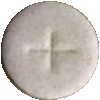
A Holy Communion wafer often features an Incused Cross or Embossed Cross, which is another form of Voided Cross.
Such crosses often decorate the front panel of church pulpits and at the ends of church pews, giving rise to the terms Pulpit Cross and Pew Cross.

© Sisters of Mercy

© 7th Day Adventists
Artistically, the style suits several emblems. Examples include those of the Seventh Day Adventists and the Sisters of Mercy.

The Voided Cross is also used for its practical as well as artistic value. The Lorena Cross shown on the left, for example, was spotted on top of a delicate bell tower in Spain. The voided style reduces the risk of the tower crumbling under the weight of a solid iron cross, and since the church is in an elevated position in a mountainous region, the design is tolerant of gusty wind.

Voided Crosses are commonly seen on gravestones.
A cross is carved into stone can be called a Petroglyph Cross (from the Greek petros; stone).

Protruding Cross
It's much easier to carve a cross into a gravestone rather than carve the surrounding stone to create a Protruding Cross, such as this Latin Cross on a gravestone.

On the right are two further protruding crosses, shaped as a St. Andrew's Cross and a Celtic Cross, baked on some Marks & Spencer Scottish shortbread biscuits. (There were a few more but I ate them.)
'Fimbriated' means 'fringed'. See also Flaming Cross.


