Burial Cross
(Click either image to enlarge)
A Burial Cross, Grave Cross or Rest In Peace (R.I.P.) Cross marks the place where somebody is buried.
For sure, when we die, we don't smell very nice. (Many of us don't smell so nice when alive, either. ) This is nature's way of protecting the living, warning us away from possible infectious disease by making decomposing corpses unpleasant to have around. Since Adam's time, we have dug holes, deposited bodies, and covered them up.
Burial is also a mark of respect for the deceased. The grave is the last resting place of the physical person and its precise location is important to family and friends. Consequently, a stone marker is used in most cultures that bury their dead.
For Christian cultures, the tradition has been to use a stone cross marker. The resilience of stone reminds the bereaved that the soul does indeed, live on into eternity.
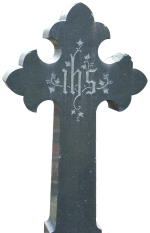
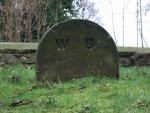
The modern cross (above left) was cut from marble; a relatively easy process with today's modern machinery. Each arm has a Fleur de Lis and the inscription is IHS. Earlier grave markers, reflecting the limitation of machinery and perhaps scarcity of masons, were much simpler and showed just the deceased's initials (above right).

The faster you get, the faster you go
The cross is so ubiquitous in graveyards that it has become a symbol for death, as shown by the small crosses in the advertising campaign to reduce driving speed.
In fact, the Christian cross is really a symbol of life (but it's a neat speed-kills advertisement nonetheless).
After death, Christians (and many of those with other faiths) believe the Messiah will return and take his followers to Paradise. The Bible details this quite clearly, even to the point of assuring us that Christ will return from the east, which is why traditionally people are buried with their feet pointing eastward so they can be raised facing Christ to welcome him on his return.
See also Churchyard Cross, Funeral Cross and Wreath Cross.
"Fish and guests smell after three days"; a saying attributed to Benjamin Franklin, Oscar Wilde, and John Lyly's Euphues & His England, II. 81, 1580.
Can people be raised if they have been cremated? Well, since God created man from absolutely nothing, recreating man from something would be dead easy; whether it was from ashes, dust, or even just the historical fact of man's existence.


