Trinity Cross

Triquetra / Trinity Cross

Triangle / Trinity Cross
Sometimes three crosses are shown clustered together, but this arrangement usually represents the three crosses on Calvary rather than representing the Trinity.
The Christian concept of the Trinity is not so clear in the Old Testament - it is a belief that was adopted in AD 325 when the Council of Nicea established the doctrine.
The belief of one God in three persons is quite unique to Christianity. Yes, Pagan and other religions may have a deity consisting of three gods or goddesses (see also Pagan items adopted by Christianity), but the Trinity is not a copy of other religious thought. It is an understanding founded on careful consideration of the Old and New Testaments of the Bible, that shows there is one God in three persons. (Confused? )

Artist's impression of the Trinity on the portal of the Basilica of St. Denis, France
Shapes, such as the triquetra or triangle, are more useful for depicting the Trinity than images often found in early Christian art (see example on the right), where God the Father is shown as a man with a beard, holding an Agnus Dei (symbol of Christ) on a cross, and the Holy Spirit as a Dove, all three being distinct and separate.
Just as the triangle might look too masonic for some people, the triquetra might look too Neopagan or New Age, showing three crescent moons for their Triple Goddesses.
The triquetra (or similar) also appears as an everlasting symbol in the Celtic charm and magical talisman known as the Clackham Cross, named after a bridge in Ireland that St. Patrick is said to have crossed. Some stores sell the Clackham Cross with the promise that it will ensure 'Serenity and Grace' — although how a piece of pewter achieves this is unclear...
So let's look at some alternative designs to represent the Trinity:


The liliform Fleurie Cross depicts the Trinity in the triple ends of each arm. However, this cross, like the Fleur-de-lis Cross, Patonce Cross and others, can appear rather secular or heraldic. The so-called Trident Cross might look a bit too neogothic for most tastes.

Triparted
The Triparted Cross is another symbol to represent the Trinity, comprising three vertical and three horizontal arms that form one cross by being woven together, somewhat like the St. Brighid's Cross. This is an Interlaced Cross, in that each piece is integrated with the others. The resulting twelve arm ends can also correspond with the twelve Apostles.
The United Episcopal Church of North America (UECNA) uses a Triparted design on the central cross in their logo.

UECNA
The other crosses in the UECNA logo are the evangelistic Jersusalem Cross in the top left quadrant and nine Mission Crosses in the bottom right quadrant, one cross for each of the nine original dioceses in the UECNA.
The layout of these Mission Crosses was inherited from the shield of the Episcopal Church in the USA. The Episcopal Church was organized shortly after the American Revolution and like the Southern Cross of the Confederate Flag, the Mission Crosses are arranged as a Scottish St. Andrew's Cross.
The Scottish link can be traced to the first American Archbishop, Samuel Seabury of the United States Episcopal Church, who was consecrated in 1784 at Aberdeen, Scotland. The UECNA still uses the 1929 Book of Common Prayer of Scotland.


Another symbol of the Trinity is the logo of the Missouri Synod of the Lutheran Church. This has three crosses forming one three-dimensional cross, with each part depending on the other two to complete the image. Several other church emblems incorporate a 3D cross.
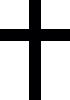
Even the simple Latin Cross can be considered to represent the Trinity. The three shorter beams represent the Three Persons of the Trinity and the longer, lower portion signifies the One Divinity.
If you are looking for a Trinity Cross design and don't fancy anything you have seen on this page, feel free to design a new one. And please share it with us!

Trinity Cross is also the name of a medal, which used to be the highest national award in Trinidad and Tobago.
This is a special medal on two counts:
- It was awarded for distinguished and outstanding service to Trinidad and Tobago. In recognition of its importance, no more than five were awarded in any year
- It was considered by some to be highly discriminatory, in that the cross is a Christian symbol and possibly offensive to 30% of the population who are Muslim or Hindu.
The term 'Trinity', if not Christian, stems from 'Trinidad', thereby being discriminatory against the 55,000 Tobagonians. Consequently in 2006 it was replaced by a new award; the Order of the Republic of Trinidad and Tobago, which is a circular medal featuring a sunburst.
See also Eye Cross for another cross featuring a triangle
Used to crucify Jesus and the two robbers
Three-in-one? Consider a woman — She can be a wife, and a mother, and a sister, and a daughter, and an aunt... yet she is just one woman.