3D Cross

Orthodox
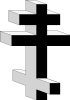
3D?
The Eastern Orthodox Cross, for example, where its lower slanting beam could be misinterpreted as an arm in a third dimension. Its similarity with a key is a convenient reminder that the cross is the key to forgiveness.

ELCB
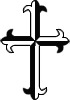
Dominican
Other illusionary 3-D crosses include the Dominican Cross (a form of Gyronny Cross), the logo of the Evangelical Lutheran Church of Brazil (ELCB), plus a few other church emblems.

A further illusion is where there is no cross at all, only three black shapes arranged in a certain position. (This style is popular tattoo design.)


The cross atop the canopy in the market square of Beverley, East Yorkshire (photo on the right) is deliberately three-dimensional. It can be recognised as a cross from any viewing angle.
Many town squares in Europe have a Market Cross. Beverley's dates from 1714, the latest renovation being in 2012 to celebrate the Queen's Diamond Jubilee.

(Beverley's six-armed cross looks uncannily like the car 'spider' wheel brace I bought from Halfords many years ago. I often wondered what happened to it.
And now I know.)
Finally, our own designs (click any to enlarge), inspired by the Dutch artist M C Escher (1898-1972), Swedish artist Oscar Reutersvärd (1915-2002), and others, who had a passion for mathematically impossible designs.


Impossible for us, but Matt. 19:26 reminds us that "With God, all things are possible."


