Calvary Cross
also known as an Altar Cross,
or in heraldry as de Calvaire, Péronnée, Degraded, Graded, or Stepped Cross

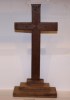
Calvaria (Latin) or Golgotha (Aramaic), is the name of a small mound outside Jerusalem's gate and means "the place of a skull" – partly because it was a place of intense suffering, and partly because the rounded skull-like appearance of the hillock.
In this symbol, the three steps leading up to the cross represent the mound at Calvary, or in descending order they represent Faith, based upon Hope, based upon Love.
The robust design is commonly used for gravestones and referred to as a Stepped Cross. Each of the three plinth steps might have an epitaph inscribed, commemorating a deceased person or family buried there. (See also Churchyard Cross and Market Cross.)
The steps are sometimes the base of a Table-top Cross or Altar Cross (top right photo). Old paintings and other artwork show that placing a cross and candles on the altar table was not common until the 13th century. Before that, a cross may have been suspended from a canopy above the altar, and particles of the Host were arranged in the form of a cross. About 800 years ago, Pope Innocent III decreed "a cross is set upon the altar, in the middle between two candlesticks" – probably only during Mass.
Altar crosses or crucifixes now can be a permanent feature in Catholic, Lutheran and Anglican churches; less so in other Protestant churches. (Reformed and Anabaptist churches usually refer to the altar as a 'communion table'. See also Communion Cross.)
Without a corpus, Calvary Crosses are often adorned with a cloth, draped over the cross-beam (patibulum). (See Shrouded Cross)
Heraldic use

Péronnée
cross
In heraldry a cross may have steps (degrees, grieces, or the French: à degrés) like the steps of an ancient pyramid. These steps could be on just the lower part, like a Calvary Cross, or on all four arms as shown in this example. Such a cross is referred to as a Graded Cross or a Degraded Cross, depending on whether you consider the steps to becoming wider or narrower, ascending or descending. (Fr: Croix Péronnée.)
The term degraded is not directly referring to the degradation suffered by Jesus on the cross, rather simply a pictorial description of the reducing sizes of the steps on each arm.
Unlike a typical Calvary Cross, the heraldic version doesn't have a fixed number of steps. There may be four, sometimes as many as eight, diminishing in size as they progress toward the centre.
Altar Cross; tautologous, since the Christian cross itself is an altar.


