Sign of the Cross
For discussion on visions of crosses seen as a sign from God, see Crosses seen in Visions and Dreams.
For a general introduction to the main cross forms, see the Crosses Index page.
Before we look into this Sign, here's a question for you: Why did the priest cross the road? (The answer is further down this page.)
The Sign is performed by Christians, especially in the Catholic, Orthodox, Anglican and Lutheran churches, during various liturgical or devotional times to remind the worshipper of the cross. Although Protestants have traditionally omitted the ritual, only a few people these days would protest that it's too 'Catholic'.
For many, the first time to receive the Sign is immediately before infant baptism. It is the parents' desire to surrender the life of their child to Christ's love and care, and the solemn indication that the infant passes from a state of sin to a state of grace.
Sign Variations
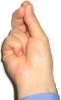
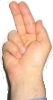
Its use can be traced back to the 2nd century, when Christians signed a cross on their foreheads in devotion and to ward off evil spirits. It is commonly accepted that St. Ignatius of Antioch (ca. 35 – ca. 107) established the practice as a formal accompaniment to devotions.
The Sign is usually made by the fingers tracing the shape of the cross by first touching the forehead, then the sternum, and finally from shoulder to shoulder. A Hand-held Cross may be used instead of the fingers.
Another form is made when blessing a person or object. In this case, the Sign is traced in the air, rather than touching the body.
And a third form is by tracing a small cross using the thumb, for example on an infant's forehead during baptism. Marking a Sign on the forehead is pretty ancient and this practice might be where Signing originated (see Tau).
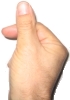
Laying the thumb across the forefinger to form a cross makes a handy(!) cross and is popular in some 'Catholic' countries such as Spain.

In each case, the Sign is made where all arms of the cross are roughly equal length, as in the Greek Cross. In printed copies of liturgical text, this 'plus sign' + (or the Latin Cross if the font character ✝ is available) is included at the point where the reader is to make the Sign.

Direction of hand movement
When the Sign is made by touching one's body, the fingers start at the middle of the forehead and then move downward to the sternum. This movement down from the head to the heart symbolises Christ coming down from heaven to earth. The fingers then move to the left shoulder and from there to the right shoulder. This symbolises Christ carrying us from the left, evil side of life, to righteousness on the right-hand side of God. For this same reason, fingers of the right hand are used.
The number of fingers used can vary, to emphasize parts of the believer's doctrine:
- Five fingers (open hand) reminding us of the five wounds of Christ.
- Four fingers (thumb folded across the palm) rarely seen, but may represent the Trinity and the Mary.
- Three fingers (middle finger, index finger and thumb) brought to form a single point symbolising the Trinity as the single divine Godhead. Users of this form include the Greek/Eastern Orthodox churches, and the Eastern Rites of the Catholic Church of the Byzantine and Chaldean.
- Two fingers (middle finger and index finger) signify the two natures (human and divine) of Christ. This is an important part of the doctrine of the Latin Rite of the Catholic Church, Anglicans, Methodists, Lutherans, Armenians and other Oriental Orthodox churches.
- One finger (index finger) signifies the single nature of Christ, favoured by Syrian and other Monophysites, more frequently referred to as Jacobites.
The size of the cross varies according to the situation. One might consider a small Sign of the Cross is appropriate as an outward display of reverence when entering a church, and a larger cross for a Sacrament.
Accompanying words
When making the Sign of the Cross, it is common to repeat the Trinitarian Formula from Matt. 28:19 "In the name of the Father, and of His Son Jesus Christ, and of the Holy Spirit. Amen" (or in Latin, "In nomine Patris et Filii et Spiritus Sancti, Amen"). The timing is usually:
- fingers at the forehead: "In the name of the Father,"
- fingers at the sternum: "and of the Son,"
- as fingers move from shoulder to shoulder: "and of the Holy Spirit. Amen."
These words are declaring the presence, and coming into the presence, of God.
There are several other phrases that some people prefer, and some churches are quite dogmatic. But of course, most important are the words said in your heart rather than merely following tradition. Similarly, whilst there are 'set' times and places where Church etiquette dictates the Sign should be made, the most important times are when you feel it is necessary.
Good luck!
Like the act of crossing one's fingers, the Sign of the Cross is often made by sportsmen before a match, students before an exam, husbands walking up the garden path after a night out with his mates, or any other time when the person needs courage or protection. The signing is a ritual for good luck. Since this is not an act of reverence, Trinitarian Formula words (see above) are usually omitted in these instances.
Question
To go back to the question at the top of this page: Why did the priest cross the road?
... to bless it, of course!
(See Luke 10:25-31 for another answer, and then read the story of St. Lazarus.)
| Other 'lucky' pages: | |
The Unicode for the Latin cross ✝ is ✝
To type a cross sign (✝) on your PC, press and hold down ALT key and type 0134 on your keyboard's number pad
Ceremonies before Baptism (Antiquities of the Christian Church)
The Sign of the Cross (Antiquities of the Christian Church)
In those days, personal belief was influenced by popular superstitions. Today, Christians are guided by reasoning.
Eastern Orthodox and Eastern Catholics usually follow the older pattern of moving right to left, and use two fingers rather than three


