Railway Station Crosses
A bus station is where the bus stops.
On my desk, I have a work station...
Railway station cross? Since when have railway stations been places of worship?
This page is mainly for railway buffs, and examines why there are so many 'crosses' in railway station names, but no actual crosses in the stations themselves.
See Stations of the Cross for information about the Passion of Christ devotion.
Railway Station Crosses

Why? We're not railway enthusiasts, so why the interest in railway crosses?
We've seen a cross outside a railway station in Canada and we've seen crosses at railway stations in Japan. But what we haven't seen is a Christian cross at any of the railway stations that include the word 'Cross' in their names.
A well-known station is King's Cross in London. The primary objective of a railway station is to dispatch and receive passengers and goods, and there is little apparent connection between it and the Christian cross. Many airports have chapels or prayer rooms, but these are conspicuously absent in railway stations.

Penza station
Things are markedly different in Eastern Europe, where some railway stations have not only a cross, but an entire church, such as this one in Penza Station.
Common Prayer services are held here shortly before the daily train speeds away on its 600 km journey to Moscow. And in central Moscow, the waiting hall of the 19th century Belorusskiy Station features a church complete with three golden onion domes.
In the West, however, most travellers are too busy thinking about their intercity journey, rather than sparing thought for their life's spiritual journey.
In Britain, the home of Anglicanism and Methodism; and in Sweden, where 87% are Lutheran; in Spain, arguably the most conservative country for Roman Catholic imagery; and near the heart of Roman Catholicism itself, the Vatican's Stazione Roma San Pietro chapels, prayer facilities and crosses are a rare sight. Even where the station includes the name 'Cross'.
So why do many names of railway stations include that word? One reason is pretty obvious: Stations are often situated where a road and railway track cross. Another reason is where the station serves railway lines that cross in different directions. And a third reason is their distant association with a particular Christian cross. But this is rare.
Brent Cross Station – England

Try asking here "What time does the next train leave Brigantia, please?" Or if you really want to puzzle the station staff, ask them where the cross is.
Bridgeton Cross Station – Scotland

No cross – just a big umbrella.
Bromley Cross Station – England

There was an old monument known as Kershaw's Cross in the area. So why 'Bromley'? And where is the cross?
Buddhist Cross at a station – Japan

Probably most crosses at railway stations are not Christian, such as this Buddhist cross at Shibamata station, Tokyo.
Although the swastika cross is ubiquitous in Japan, not many stations are built next to Buddhist temples for obvious reasons. But if you tour the country, or indeed any country, and see a cross at a railway station, please let us know.
Japan has a huge community of railway enthusiasts, as can be seen in this brilliant video of a 1930-era model built by Kanji Yoshioka in his home not far from Tokyo; all the more remarkable given the comparatively small houses in Japan.
Charing Cross Station – England

The cross is not a cross shape, and its name is not Charing. So what is it?
Clay Cross Station – England

No clay, no cross, and no station.
Foss Cross Station – England

A model for passenger comfort and safety.
Fredericton Station – Canada
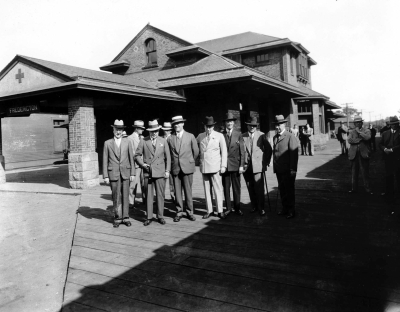
The only station on this page without 'Cross' in its name, Fredericton is the only one in the West we know of that actually has a cross!
Gerrards Cross Station – England

A modest station for one of the most exclusive areas of Britain.
Glasgow Cross Station – Scotland

The rise and fall of the Second City of the British Empire
Harman's Cross Station – England

Harman's Cross Station, synonymous with 'cute'.
Hatton Cross Station – England

Hatton was originally called 'Heath'. Coincidentally, the station is now adjacent to one of the world's busiest airports called 'Heathrow'.
Hautere Cross Station – New Zealand

Hautere Cross Station – seemed a good idea at the time.
Hunts Cross Station – England

None at the station, but there are several in the area: At Hunts Cross, Cronton Cross, Woolton Cross, and Garston Cross.
King's Cross Station – Australia and England

A cathedral more famous for prostitution and drug dealing than the message of the cross.
Kirby Cross Station – England

To see the Kirby Cross, you must be in the right place at the right time.
New Cross Station & New Cross Gate Station – England

Despite its rather sad facade, New Cross station has a great wealth. The original 'cross' was golden.
Poison Cross Station – England

Legends abound. Who knows if any of these inspired the Brazilian feminist Inez Haynes Irwin for her 1936 mystery novel The Poison Cross
Red Cross Station – French Alps and Micronesia


Ooops! You've come here by mistake.
These are first aid stations, not railway stations!
Southern Cross Station – Australia

This station roof has made some people very cross
There is more than one Southern Cross Station in Australia, and each one is named after the biggest cross to be seen. (But only at night!)
Vauxhall Cross Station – England

There is a place called Vauxhall Cross, but is there a Vauxhall Cross Station? Is there indeed any Cross there?
Waltham Cross Station – England

See this cross while you can – it is shrinking at an alarming rate.
One thing we've discovered in building this page, is that railway enthusiasts have very deep knowledge in their subject. And they're pretty accurate with their facts, too. If you notice any errors or omissions on this page, or if you know of other 'Cross' stations anywhere in the world, please email us, including any information you have about the name's origin.
The crosses seen at railway stations in Japan are not Christian crosses – see Health and Safety symbol at Oimachi Station and Buddhist Cross at Shibamata Station.
In Muslim countries such as Indonesia, most railway stations have a Mushala (small Mosque) for travellers to perform Shalat, one of the obligatory five times to pray each day facing the direction of the Kaaba shrine in Mecca.
St. Peter's Station of the Vatican State Railway
An exception to this is perhaps the occasional war cenotaph or a memorial erected following a fatal train accident. In old Italian railway stations in the countryside, you might find a small cross installed by locals, but these have no official railway company mandate.
Europe's largest station, the Berlin Hauptbahnhof (Berlin Central), for example


