Tomoe and Cross
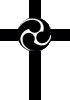

So what has that to do with the Christian cross?
For those promoting interreligious dialogue, a combined symbol of a Tomoe and a Cross represents how people of the two religions can come together and learn from each other's tradition.
Both Buddhists and Christians recognise the importance of respect for another's tradition, and for an adherent of one religion to speak meaningfully to an adherent of another, it is necessary to first have clarity and a depth of understanding of one's own tradition.
The Tomoe symbol is used as an aid for meditation. It looks like an arrangement of three teardrops, chasing one another round a circle; or reversed commas or 6's or 9s.
Since this appears in contemporary jewellery, especially with surfers, it is often considered a relatively modern design. Yet the symbol and its variants pre-date the Christian cross by at least 1,000 years.

Borromean
On the left (click the image to enlarge) we see one of many variations of a Japanese mon (family crest). The three curves in this particular symbol are arranged as Borromean rings, which were popular in the Baroque era, especially in Italy. Yet the history of Borromean rings is much older; appearing in Viking and ancient Pagan art.
Borromean rings and knots have been used by so many ancient cultures and it's not surprising that they appear in a Christian context. Saint Augustin of Hippo (354-430) explained the Trinity through his work De Trinitate (ix, 5, 7), showing that these three rings could be of one substance. Their use in Christian icons has since been widespread.


The tomoe, however, is seldom a full circle. Japanese magatamas, for example, have been found in Jomon-era burial chambers in Tohoku. The one on the right was shown to us by an expert in ancient Far Eastern artefacts. It is jade, from a site in Korea, dates from c.350 A.D., and carried in the pocket of this gentleman at all times as a lucky charm.
Other variants of the symbol found in Korea are known as sam-taegeuk, and in Tibet we find gankyil. In Northern Europe, the symbol today is used by Germanic Neopagans, and also in the UK (such as the Odinic Rite). The shape is also the basis of each half of the Yin-Yang.
One common understanding of the Tomoe is the representation of rotation of life, rebirth and continuity.

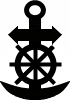
An alternative symbol to represent Buddhism is the Dharma wheel (see also the symbol of the Pagan Taranis wheel). This has similarities with the ship's wheel in the Anchor Cross.
On its own, the Christian cross can symbolize various things: For example, the four arms representing the four Evangelists, or the three short arms representing the Holy Trinity with the lower arm representing the One God. Similarly, the Tomoe and the Dharma wheel may represent different things within Buddhism.
As with the Tomoe, the Dharma wheel can represent the rotation of life, rebirth and continuity. The Christian cross has parallels to this.
Similarly, both Buddhists and Christians spend a lot of time in meditation and prayer. This is one of the areas from which interreligious dialogue can lead to mutual benefit of a renewed understanding of one's own beliefs.
Such reflections shouldn't remain in the cloisters of the monastic elite, and should not lead to hypocrites, such as The Pilgrim's Progress character 'Talkative'. Rather the education should be exploited to the full in the practical execution of God's will.
No connection with the biblical 666
Modern mathematics too, not to mention Venn diagrams, the mainstay of so many management training courses. Each ring links to just one of the other two and if that ring is broken, then the other two fall apart.
That's an entire week's management training in just one short sentence!