Coptic Cross
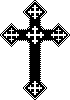
The Coptic Church is the main Christian Church of Egypt, established by Mark in the 1st century (around 60 AD). The Church now also has dioceses around the world and in particular Africa and the Near East.

Coptic cross by Lanternix, June 2009

Coptic cross by Seiyaku, June 2010

Coptic cross given by Pope Shenouda III, Sept. 1989
The early Gnostics and Copts quite possibly adapted the Egyptian Ankh Cross as the basis of its emblem, which then evolved as the sect spread. The Ankh is found on numerous antiquities; for example the 6th century sandstone grave marker found in the pre-dynastic area of El-Badari, Upper Egypt (see coptic-cairo.com/museum). The Ankh is also seen in the logo of American Coptic and the political group, the United Copts of Great Britain.
Old Coptic crosses often incorporate a circle; sometimes large, sometimes small. The circle of the Ankh originally represented the Sun god. For the Coptic Church, the circle represents the eternal and everlasting love of God, as shown through Christ's Crucifixion. It also symbolises Christ's halo and resurrection. Christ's resurrection is central to Coptic doctrine and perhaps for this reason, Coptic Crosses are more usually seen without a Corpus.
As Copts migrated from Egypt, so their cross style was influenced by different cultures; in particular, North Africa. Today's Coptic churches tend to use trefoil crosses and the crosses shown above on the left are typical.
 Budded and trefoil crosses on the tower of a Coptic church in Cairo |
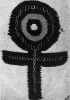 4th century woven Ankh at the State Pushkin Museum of Fine Arts, Moscow |
 Ethiopian Coptic cross |
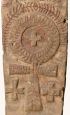 Ankh: Coptic Cairo Museum |
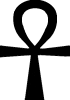 Ankh: United Copts of Great Britain |
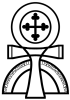 Ankh & Rainbow: American Coptic |
Ethiopian Coptic crosses can be so sophisticated that it's difficult to find a cross in the design. For example, the Ethiopian Cross, an elaborate baroque style or filigree reflects the richness of the hearts of people in the Coptic Church.
(See also Exploding Cross)


