Snowflake Cross

This page introduces an alternative use of the word, with the Snowflake Cross
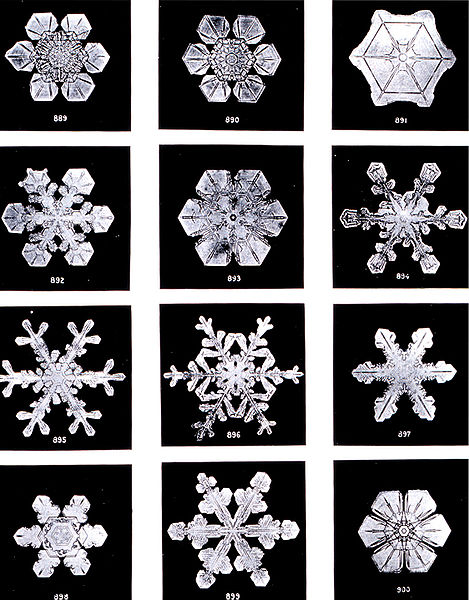
The photo shown on the right is perhaps the earliest one of a snowflake, taken by Wilson Bentley in 1902 (Click image for more)
When water freezes, its molecules stack together to form a regular crystalline ice lattice, which has six-fold symmetry. It's because of this hexagonal crystal symmetry that practically all snowflakes have six arms. (The BBC explains this beautifully in their short video on the science of snowflakes.)
Most Christian crosses have four main arms but some have a few more thin arms, creating a delicate filigree appearance that reminds us of snowflakes.


On 5 August there's a festival Santa Maria ad Nives (Our Lady of the Snows), to remember how the Mother of God is believed to have founded a church on the spot where snow miraculously fell one summer.
A sculpture is carried to the chapel in Kukljica by boat and the community's flag bears a Snowflake Cross to symbolise this. While Kukljica’s flag preserves the symbol in heraldry, we also find striking physical examples in Eastern Europe.

Smilgiai church
Snowflakes land on roofs, and an example a Snowflake Cross of can be seen atop Smilgiai Catholic church in Panevėžys, Lithuania.

Vytachiv chapel
Another example is in the photo on the right - a Snowflake Cross crowning an old wooden chapel in Vytachiv, a small village in the outskirts of Kyiv in Ukraine.
It's an interesting example because usually crosses in this area have the traditional Ukrainian Orthodox design.
The spiky style also makes a useful lightning conductor. A further possible reason the cross on the chapel has survived so long, is because the intricate design prevents heavy eagles (orel) from using it as a perch.
That was until February 2022, when Russia invaded Ukraine.
The chapel's cross is safe from eagles, but not so robust against thousands of drones, cruise missiles and tons of explosives.
And what about the snowflake as a metaphor for war? World leaders and the people who elect them, give the same excuse as the snowflake does in an avalanche... "It's not my fault."
And finally...
- Ivan: "Did you know, that no two snowflakes are alike?"
Alexei: "Wow! You've been busy this winter!" - Way back in the 40s, before Moscow became a modern, throbbing city, when life was hard and pleasures simple, people used to go out for relaxing evening strolls.
One cold winter's night, a couple of Muscovites were walking down the street, when the man felt something splash on his nose. "I think it's raining." he said to his wife.
"No, that felt more like snow to me." she replied.
"No, I'm sure it was just rain." he said.
Well, they were about to have a major argument about whether it was raining or snowing, when they saw a Red Army colonel walking towards them. "Let's not fight about it," the said man, "let's ask Colonel Rudolph whether it's officially raining or snowing."
As the officer approached, the man said, "Tell us, Colonel Rudolph, is it officially raining or snowing?"
"It's raining, of course!" he replied, and walked on.
But the woman insisted: "Well that certainly felt like snow to me!"
The man quietly replied: "Rudolph the Red knows rain, dear."


