Rainbow Cross
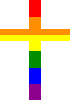
We usually say there are seven colours in a rainbow but this is a bit of an understatement. A rainbow is an arched spectrum of light that we see in the sky when the sun shines onto raindrops. It has thousands of different colours.
Without getting too deep, let's just look at some basic things about colour:
Colour

We might remember being taught at school that there are three primary colours (red, yellow and blue), and mixing these, we can get the three secondary colours:
red + yellow = orange,
yellow + blue = green,
and blue + red = violet.
Each colour has a wavelength, as we see in the chart on the right.
Beyond the red 780 nanometres (nm) mark, we have infrared, which we cannot normally see with the unaided eye. And beyond the violet 390 nm, we have ultraviolet, which again, is outside our normal vision.
Even though we cannot normally see ultraviolet and infrared light, these wavelengths can be very useful: from stimulating production of Vitamin D in the skin; to remotely detecting potential sick people arriving at airports; to reading the Dead Sea Scrolls; to the possibility of taking photographs using 'invisible' flash.
Mixing the primary and secondary colours gives us more colours (for example red + orange = salmon) but the wavelengths of these tertiary colours are not nearly as wide, and therefore not as visible as the six cardinal colours.
And there we have it. Only six main colours in the rainbow.
So what is the so-called seventh colour?
The answer is indigo, a tertiary mixture of blue and its neighbouring colour violet. Indigo has a very narrow band (around 450-440 nm), and as such, has very little reason for being included in our description of the rainbow.
Music
So why is rather drab indigo colour there? Well, when astronomer, natural philosopher and Unitarian Isaac Newton divided up the visible spectrum, he decided there should be seven colours to link them with the seven 'planets' known at that time.

Seven planets, hence seven days of the week. Twelve phases of the moon, hence twelve months of the year. One of Newton's missions in life was to show an integrated and harmonious cosmos. He felt it was no coincidence that the musical chromatic scale had twelve pitches, each a semitone, above or below its adjacent pitches, and that the diatonic scale had seven notes (do-re-mi-fa-so-la-ti).
Newton was keen to show the relationship between colour and music, although he seems to have ignored the important difference that the musical scale is cyclic (i.e. it repeats at each octave - see prgomez.com/why-do-re-mi/ for a simple explanation) whereas the colour spectrum is not.
Nevertheless, he decided that red corresponded to D on the musical scale and therefore indigo became B (going down the colours and up the scale). Maybe the frequency (490.55Hz) of that note gave Newton a Mood Indigo, later immortalised by Duke Ellington in 1931.
There have been many theories that pitch and colour are mysteriously related. To name a few, the romantic composers Alexander Scriabin (1872-1915), Hector Berlioz (1803-1869), Claude Debussy (1862-1918) and Richard Wagner (1813-1883), all had interesting ideas. (See the excellent, easy-to-read, discussion on the relationship between pitch and colour at mathpages.com/....)
Ribbons
After World War II, there was a medal given to soldiers involved in the D-Day operation. This was the Operation Overlord Medal and the rainbow colours were used for its ribbon. The rainbow ribbon was also used for the First World War Victory Medal. Now, of course, not many people can remember what the victory was, who was fighting, and why. That makes the 21,241,000 wounded and 8,281,250 killed seem more futile than victorious. (See also Rainbow Ribbon.)
Symbolism
The rainbow is also symbolic of a halo and since the time of Adam and Eve, the rainbow has been considered both beautiful and mysterious. Small wonder that rainbows appear as good omens in mythology. To the ancient Greeks, the rainbow was a path leading to heaven. We find similar beliefs in China, Africa, India and Europe. And in Ireland, the little leprechauns are said to have hidden their pot of gold coins at the end of the rainbow (but nobody knows why).
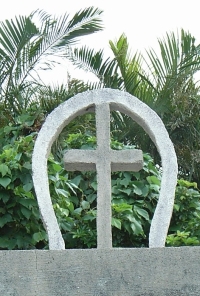
This cross enshrined in an arc was spotted above a Christian tomb in Okinawa
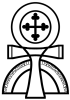
Rainbow beneath an ankh on the logo of American Coptic
The arc of the rainbow looks like a bow, facing the heavens. Turning the bow on oneself is believed to have been an ancient symbol to declare a cessation of hostilities.
In the Old Testament, the rainbow is a symbol of the covenant between God and man after the great flush. The Rainbow Cross indicates that the same God who saved Noah and his family, now extends that salvation to us all. (Ethiopians actually honour seven covenants, the second of which is the rainbow of Noah.
The meaning of the Christian cross is well known. But the Rainbow Cross has recently acquired a more specific meaning.
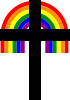
The rainbow shows us the full spectrum of colours and is universally accepted as being good and natural. It is used in hippy peace designs, and it is used by Jesse Jackson's Rainbow Coalition to show that all colours are needed to make the universe whole. It shows that the world is composed of diverse people, in terms of race, colour and ability. It is used by people who have different sexual orientations, particularly gay people.
On 27 November 1978, Harvey Milk, the city's first openly gay supervisor, was assassinated along with Mayor George Moscone. The turnout for the 1979 San Francisco Gay and Lesbian Pride Parade was massive, due to the publicity and anger over Harvey Milk's killing. The Parade Committee decided to use a rainbow flag, designed by Gilbert Baker, as a symbol of solidarity for gay people. For the grand parade, they removed the indigo stripe and then divided the flag into two: red, orange and yellow stripes on one side of the street; green, blue and violet on the other.
Since then, the six-colour flag has been the symbol for gay rights and equality around the world. Gay Christians have used the Rainbow Cross as their awareness symbol. As explained above, there are only six main colours in a rainbow; a phenomenon as natural as sexual orientation.
Whatever your view might be about Homosexuals and the Church, the rainbow is generally considered, like the halo, a 'good thing' and often appears on, or with, a cross as a peace symbol. It reminds us of God's love and purity.
Source: The Longman Companion to the First World War (Colin Nicholson, Longman 2001, p248)
- the Matrimony of Adam and Eve (Gen. 2:21-25, Matt. 19:4-6)
- the Rainbow of Noah (Gen. 9:8-17)
- the Bread and Wine Offering of Melchizedek (Gen. 14:18-20)
- the Circumcision of Abraham (Gen. 17:1-14)
- the Ark of Moses (Deut. 5)
- the Throne of David (2 Sam. 7:8-16)
- the Crucified Body and Blood of Jesus Christ, born of the Virgin Mary (Matt. 26:26-29)
If you are reporting on diversity, see the Right Way to Write
The man convicted of the killings, Danny White, was sentenced to only seven years and eight months in prison, and served only six of these before being paroled. His defence lawyer argued that White could not be held accountable for his actions, due to the amount of junk food he had eaten on the day of the killings.
"Gay Pride" is a rather silly term. Most gay people believe that being gay is a state, not a choice or achievement; just as people who are not gay did not make a choice about their natural preferences. "Unashamedly Gay" is perhaps more accurate.
The Rainbow Cross is a convenient teaching aid for very young children. "Look at the pretty rainbow on this cross; it reminds us that God is love." can be easier for toddlers to take in than "Look at this wracked crucified man in agony; it reminds us that God is love."