Crenel Cross

Crenel

Dovetail

Ragulee
The Crenel Cross, sometimes called an Embattled Cross (Fr: Croix Bretessée), is a heraldic cross and symbolises strength.
Stylistic variations include the Dovetail Cross (see Dove Cross) and the Ragulee Cross (also Raguly, Ragged or Rugged Cross).
In a religious setting, it can be symbolise 'Church Militant', that is, the church here on Earth as opposed to 'Church Triumphant' (the church in heaven), or in Roman Catholicism 'Church Suffering' (the church in Purgatory).

Gravestone in Rudna Glava, Serbia. Photo by Nenad Bačilović
(Click image to enlarge)
It is, however, mainly seen in heraldry. A possible exception is the late-19th century crenelled gravestone shown on the right. This was photographed in a Rudna Glava village in eastern Serbia and may have Vlach influence.
As far as we know there are no detailed cemetery records to indicate whether the deceased had a senior civic or military role, so we don't know if this crenelling is heraldic, religious or perhaps just the whim of the mason or the deceased's relatives. If you have information about this, please let us know.
Crenel (or crenelle) comes from the Latin crena, which means 'notch'. A similar word in English is 'cranny', as in 'nook and cranny'.
Crenel is an architectural term used to describe an indentation, particularly in a battlement you might see atop the turret of a medieval castle or fort. The complement of crenel is merlon. In other words, the gaps in a parapet are called crenels; the raised bits of wall between them are called merlons. For the Crenel Cross, understanding these different terms is important.
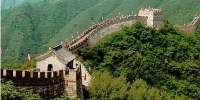
The Great Wall of China is, we're reliably informed, NOT visible from space. (We're also reliably informed that space IS visible from the Great Wall of China.) Chinese astronauts have confirmed that the wall cannot be seen from space with the naked eye. Even with a telescope, it's hard to distinguish from the surrounding landscape due to wall's stones which blend with the surrounding terrain.
The wall has around 10 million crenels, and a similar number of tourists tramping over it every day.
It was built by various dynasties over several centuries, starting as early as the 7th century BC by conscripted soldiers, peasants and prisoners, or so the official tourist guides state.
But we believe it was actually built by the great 'hentrepreneur' Balbus.
In battle, the defenders behind the battlements are protected from incoming missiles by merlons and they fire their arrows or cannon through the crenel. So when we refer to a Crenel Cross, we think 'attack'.
Attack and defence are opposites, but we often use the word 'defence' as a euphemism for war. If this cross was being invented today, we'd no doubt use the euphemism Merlon Cross. Strange language is used in warfare, and when you think about it, some of our choices of words are quite silly. For example, the oxymoron 'Humanitarian war'.
Weaponising euphemisms
'Adult entertainment' is a euphemism for 'pornography' and 'rest room' is a euphemism for 'toilet', even though one doesn't go there to 'rest'. A euphemism is the substitution of a more favourable term for another expression. Innocuous sounding euphemisms can usefully avoid causing offence.
But it's more offensive, obscene in fact, to use euphemisms to desensitize mass killing and conceal the evils of war when the objectives are to mislead the public, prevent shareholders from pulling their support away from the arms industry, and enable politicians and their voters to sleep at night.
Euphemisms can sanitize things or conceal realities, which, however harsh, should be exposed. Hitler's euphemism for genocide was 'final solution' and from the outset of the much later wars in Afghanistan, Iraq (Desert Storm, etc), Ukraine (military operation), etc. several notable examples appeared.
Saying a toilet is a place for resting is just silly. Saying "alternative facts" instead of "lies" is to avoid political embarrassment. (In January 2017, US presidential counsellor Kellyanne Conway referred to "alternative facts", but ended up with people ridiculing her and created more public attention on the actual lie.)
Here are a few more:
| We say: | We mean: |
| defence expenditure | military expenditure |
| military intervention | use of deadly force |
| armed services | people we pay to do our killing |
| boots on the ground | sons sent out to kill people |
| civilian contractors | mercenaries / higher paid killers |
| debriefing | interrogation |
| enhanced debriefing techniques | torture |
| Manifest Destiny | The 19th-century term used in the United States to justify taking over land owned by other people. The concept was based on the belief that it was their divine right to expand across the North American continent and beyond, at the expense of Indigenous peoples - in other words, taking over land that God had mistakenly given to other people. It's now accepted as being utterly wrong, a mistake not to be repeated. And yet... |
| liberating the oppressed | a convenient term to secure public support for invading nations that happen to have our oil under their sand, thereby correcting God's geological mistake |
| Operation Iraqi Freedom | liberating the oppressed (see above) before the Chinese get there. Make sure also that we all get a campaign medal, including cooks and pay clerks. |
| reconstruction | any means employed to generate and sustain cycles of violence, so that billions of our tax dollars can be handed to US companies; a short-term business view that disregards the risk that cycles of mass violence might well lead to nuclear terrorism sooner rather than later |
| patriotic | gullible |
| unpatriotic | unafraid to follow one's conscience (in other words, being genuinely patriotic) |
| a just war | invading a country that has a wicked ruler or a country which you think might attack you one day, even though the United Nations Charter specifically forbids such pre-emptive action (This rule was originally written at the behest of the United States)
The historical origin of the phrase "just war" is quite interesting. Read here |
| war criminal | one who breaks international law, unless they happen to be a leader of a rich and powerful country |
| theatre | death zone |
| pacification | bombardment |
| Critical Incident Stress Management Unit | mental health workers who treat morgue staff |
| Health Alteration Committee | CIA's department of assassins, c.1960 |
| incontinent ordnance | a missile that goes off target, potentially killing civilians |
| soft targets | defenceless people to be killed; encouraging those who survive to retaliate, thereby prolonging 'reconstruction' (see above) |
| clean up | kill anyone who hasn't managed to run to safety |
| collateral damage | people killed |
| body count | the number of people killed |
| surgical strike | kill people, but make it sound like a highly-skilled surgeon operating to save the patient's life; i.e. not operating to kill that patient |
| encounter | kill people |
| neutralise | kill people |
| engage | kill people |
| contact | kill people |
| regime change | kill more people than the regime killed |
| stay the course | kill people |
| kill people | (term not used) |
... and so the list goes on. As Timothy Lynch says: "By corrupting language, the people who wield power are able to fool the others about their activities and evade responsibility and accountability." cato.org/pub_display.php?pub_id=6654
There are much better articles than our summary above, which open the eyes to the careful way euphemisms have been created for political and financial gain. See, for example, Military Euphemisms, by David Watts.
“The world is being ravaged by a handful of tyrants, yet it is held together by a multitude of supportive brothers and sisters.”
“They [tyrants] turn a blind eye to the fact that billions of dollars are spent on killing and devastation, yet the resources needed for healing, education and restoration are nowhere to be found.”
“Woe to those who manipulate religion and the very name of God for their own military, economic or political gain, dragging that which is sacred into darkness and filth.”
Pope Leo XIV, during a speech at St Joseph’s Cathedral in Bamenda, Cameroon, on 16 April 2026
When the power of love overcomes the love of power, there will be peace. Then we won't need those euphemisms.
In Norman England, noblemen could only include battlements in their buildings if a 'licence to crenellate' had been granted by the king or an authorised bishop. Today, local planning officers probably don't mind too much, unless you start firing arrows or cannon from battlements.
And if you fancy a puzzle, see if you can explain why battlements appear on this symbol.


