Skull and Crossbones
and its use in Christianity

The Skull and Crossbones is associated with death. But in what context?

The ☠ symbol has been used, and continues to be used, in a wide variety of ways: It has been used by Masons (often replacing the bones with a crossed hoe and sceptre) and also used by the secretive 'aristocratic' Skull and Bones Society, with its dubious agenda. It has been used on industrial warning labels for poisonous substances, Halloween party costumes, heavy metal rock bands and the punk subculture.

Pharaoh Ramesses II
1302 - 1213 BC

Disney's Pirates of the Caribbean

A burglar would be daft to dress like this
As a symbol of the deceased, a common idea is that the two bones represent crossed arms, forming a sign of the Christian Cross over the body. However, this custom pre-dates Christianity, as seen in Egyptian mummies of royal males such as Ramesses the Great. This was perhaps seen as a defensive posture to protect the departed in the next life.
In fact, rather than arms, the bones of the Skull and Crossbones are usually two femora (thighbones) which are the longest and largest bones in the body. The skull and these bones can survive much longer than the rest of a skeleton and therefore symbolise extended time; a long time beyond death. In other words, it's a symbol of the very dead.
This fearsome image was copied by pirates onto their 'Jolly Roger' flag as a bravado display of their fearless lifestyle. Pirate Calico Jack is reported to have flown a Jolly Roger flag depicting a skull and crossed swords.
We doubt that many pirate ships actually flew the skull and crossbones flag, and perhaps not as many as movies suggest. To do so would be self-defeating; potential victims would flee the area and military ships would chase after the pirates. It's about as likely as a burglar wearing a striped jersey and eyemask.
The skull and crossbones (or at least the skull) symbol has been used by military units for many years: In WWII by the German Army's Nazi Death's Head Division (SS-Totenkopf Verband), the British Royal Navy and Royal Australian Navy, and earlier in the Crimean War by the British Army's 17th Lancers regiment.
It's currently used by the outlawed Chetnik Movement (Serbia and Montenegro), the British Queen's Royal Lancers, the Royal Navy including the Submarine Service, and the US Navy. It demonstrates their pride after a killing and is supposed to help instil aggression in the servicemen.
The threat of death, it seems, is to be feared. Yet death happens to all of us eventually. The skull and crossbones image has been used in graveyards, catacombs and crypts, especially in areas with a Spanish influence, to remind us of our immortality; as though the surrounding graves were not a sufficient reminder.

Silvered altar cross from Germany
(Click photo to enlarge)
The ☠ symbol is sometimes seen at the base of Christian crosses, particularly those bearing the corpus of Jesus. And this has two common interpretations:
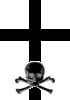
The first (somewhat feeble) interpretation points to geographical location of the Crucifixion. Jesus' cross was at a location named Golgotha (from the Aramaic gulgulta 'place of the skull' and from the Hebrew gulgoleth 'skull'), which is a small rise outside the gates of Jerusalem, and also known as Calvary (from the Latin Calvaria).
A Hebrew root of the word Golgotha means 'roll', as in the dome-shaped mound resembling the top of a skull. And this is where the logic falls flat on its face. The skull is the bony structure of the entire head, and the bit at the top is called the cranium.


The second interpretation is more favoured; suggesting that the skull and crossbones represent Adam. Lettering to this effect is written on some Eastern crosses and Jewish tradition holds that Adam's remains were taken by Noah, passed on to Melchisedech, who buried them at Golgotha.
The authenticity of this story is not as important as the symbolism. The flow of Jesus' blood down from the cross onto the skull of Adam, who committed the first sin, represents the sacrifice of Jesus that washes away the sin of mankind. Including you and me. (see Meaning of the Cross)
The Christian cross, whether adorned with a skull and crossbones or not, represents both spiritual death and spiritual life.
(For crosses relating to physical death, see Funeral Cross.)
The Skull and Crossbones, together with a cross, is sometimes referred to as a Death Cross. However, these days Death Cross is a financial markets term to describe a crossover resulting from a security's long-term moving average breaking above its short-term moving average or support level.
(Some people spend all day staring at averages, and get paid for doing so. It's a strange world.)
Pirates were, and still are, not 'brave'. Like the bullies at school, in the workplace, the home, and even at church, they are just powerful individuals who choose to abuse those who are less powerful. An example of another pirate is Olivier Levasseur
I plan to live forever. So far, so good.


