Paternoster Cross
also known as the Rosary Cross
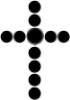
"Our Father" (L: Pater Noster), are the opening words of the Lord's Prayer taught by Jesus to his disciples (see Matt. 6:9-13 and Luke 11:1-4).
As an alternative to a rosary string, this cross has been found on the walls of ancient Roman villas, with the letters A and O being the Latin equivalents for the Greek Α (Alpha) and Ω (Omega) terminating each arm showing Jesus to be the beginning and end, i.e. eternally divine. (See also the Alpha-Omega Cross.)
Today, the Paternoster Cross or Paternoster Beads are used by Roman Catholics, some Anglicans, Lutherans and others. In the Eastern Orthodox tradition, a knotted or beaded Chotki or Komboskini is commonly used. Most Protestants however, do not feel such beads and the associated devotions are a critical aid to contemplation.
The prescribed prayer said with the rosary consists of making the Sign of the Cross and then saying:
- The Apostle's Creed
- The Our Father
- Three Hail Marys
- Glory Be to the Father and O, My Jesus
- Announce the First Mystery, then Our Father
- Ten Hail Marys whilst meditating on the Mystery
- Glory Be to the Father
- Announce the Second Mystery, the Lord's Prayer, ten Hail Marys, Glory Be
- Continue with Third, Fourth and Fifth Mysteries in the same manner
- Hail, Holy Queen
The Paternoster Cross offers a subset of this. The supplicant touches the larger central bead when saying the Our Father and a smaller bead for each of the ten Hail Marys. Glory Be to the Father can be said at the end of the devotion. As with many other religions, bead counters help to keep track of where you are in the prayer.
A rosary normally has sixty beads, plus a crucifix so to call this a Rosary Cross is somewhat misleading. Other names for this cross include the Our Father Cross and the Lord's Prayer Cross. In heraldry it is known as a Nebulée Cross, meaning 'small clouds'. An alternative heraldic name is the Invected Cross (Fr: Croix Cannelée), from the inward pointing spikes along each cross beam. The inverse of this (spikes pointing outward) is the Engrailed Cross.
See also Prayer Cross.
The Apostle's Creed
The Lord's Prayer
Hail Mary
Glory Be to the Father
O My Jesus
Hail, Holy Queen
Pray for us, O holy Mother of God
That we may be made worthy of the promises of Christ. Amen.


