Sun Cross
Page 2
The meaning of the sun symbol in Christianity
We're not suggesting that Christians worship the sun, but is the religion based on ancient Pagan Sun worship?
About 1,500 years before Christ, the Prophet Zoroaster (or Zarathustra) founded a religion that became the most powerful in the world. Zoroastrianism was the official religion of Persia (Iran) from 600 BCE to 650 CE.
One of their symbols was fire but they were not, and are not, fire-worshippers. Zoroastrians believe that fire is a pure element and therefore a suitable representation of God's light or wisdom.
Similarly in Christianity, fire is used to represent the Holy Spirit. And the largest and greatest fire we know of is the sun.
Ignoring for the moment that some early Christian art deliberately mimicked Sun gods as a disguise (see Trident; a Disguised Cross), circles do feature a lot in Christian art. The circle is a common and popular shape in many art forms, not necessarily depicting the sun. We see lots of straight lines in Christianity too.
The cross is usually two straight beams, and from a young age we are told to 'keep on the path of life that goes straight. If we look at the sun image as just a bright circle, then we can easily debunk some of the Christian Sun-worshipping ideas:

The halo, for example, was never intended to be a sun. The word comes from the Greek halos, which means the ring of light shown around the sun, not the sun itself.
The word was borrowed for the name of the light, real or imaginary, appearing around a holy person. Artists have used this to represent an aura or spiritual light from holy people "The righteous shall shine forth as the sun in the kingdom of their Father." (See also Halo Cross)
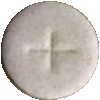
The communion wafer is round because baking a round biscuit is easier than any other shape - just mix the ingredients, plop the mixture on a tray, and bake. It's only when space is a premium do we shape the mixture into squares.
Roundness became a natural shape for bread, biscuits and cakes. And they look nice on round plates.

Church buildings have many rounded features such as this church dome because, like the biscuit, round is easier and stronger.
When man first began building homes, he found a round hut was stronger and easier to build than a square structure. When the village ran out of space, square houses began to appear.

The monstrance is an important item in the Catholic Church since it displays the sacred Eucharistic Host. Earlier (medieval) vessels looked nothing like a sun; they were elaborate tabernacles or shrines. But by the 15th century, churches decided it was better to have smaller, less elaborate vessels, that would focus the eye better to the Sacrament. Thus the sunburst was chosen as a 'look here' design.
So if the monstrance 'proves' that Christianity is based on worshipping the Sun, then this is something that only began in the 15th century.

The Salvation Army, in terms of grandeur and liturgical finery, is about as far removed from the Catholic Church as you can get (although they do have their own significant number of ceremonial customs).
The blue border on their flag represents the royalty of Christ, and the red represents His blood. The yellow bit in the middle is not meant to represent the sun; rather it represents the fire of the Holy Spirit. Indeed, they don't even call this part of the flag a 'sun'; they call it a 'star' and have done since the Salvation Army started work in India, in deference to the Indian Parsees who regard the sun as sacred.
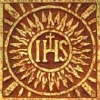
Yes, the Jesuits use the sun as the symbol of Jesus Christ. The Jesuits are pretty conservative on cosmological issues and like all Christians, they believe that Christ is the Light and the Life. So why not depict this using an object we are all familiar with?
Their choice of the sun is appropriate: When Jesus appeared before his disciples, "his face shone like the sun, and his garments became white as light." The sun is used to remind us of the glory of Christ.
And of course there is the homophone 'the sun' and 'the Son' (Jesus), the Light of the world.
"But unto you that fear my name shall the Sun of righteousness arise with healing in his wings;" Mal. 4:2 (KJV)

Sun worship
Sunday is the day Christians set work aside so they can worship and we must thank old Egyptian astrology for naming this day for us. They identified seven planets and named the greatest of these 'sun'.
Each day was named after a planet and the first day of the week, according to the Jews, was labelled after the greatest planet, the sun. Hence we have Sunday. Saturday became the seventh day for the Jews, and that was their day of rest (Sabbath).
The purpose of having a rest day each week was to enable the body to recharge itself for another week's labour. At the same time, man could refresh his spiritual body, by spending the day in worship. Christians decided the first day of the week would be appropriate for their Sabbath perhaps because Christ's resurrection took place on Sunday which became known as the Lord's Day. Sunday became the day to celebrate the Eucharist. It also gave Christians the advantage of not following a Jewish tradition of a Saturday Sabbath.
Roundness is nice, but that doesn't make it a god.
Say the word 'GOOD', and notice the round shape of your mouth. Say the word 'EVIL' and notice the sharpened features of your mouth. Also notice that the letters in the word 'GOOD' are rounded and the letters in 'EVIL' are angular. ('TAX' is another angular word!) Of course all this proves nothing, other than to show that with a little imagination, all sorts of nonsense theories can be made up from coincidences.
There is good reason why halos and sun rays are included in Christian art, just as we see in ancient Greek, Roman, Buddhist and other Asian religious art. The light represents glory and the grace of God shining forth through the image.
The god called Sun
It's easy to understand how ancient man would look at the sun as the most powerful god. Today, we are more enlightened and know that the sun is just an enormous ball of gas. We also now know that it's not unique - there are countless other stars visible to the naked eye, some of which are much brighter than our sun.
Where in the past man believed there were a countless number of gods, we now have the intelligence to reason that there is only one supreme God.
Return to page 1
See also Glory Cross, Flaming Cross, Rising Sun Cross and the Star Cross.
Is it 'Sun' or 'sun'? We've tried to be consistent; capitalising Sun when referring to the name of the Pagan god, and 'sun' when referring to the physical star.
Mathew 13:43
Matt. 17:2
Possibly for similar reasons, the groom at a Christian wedding stands to the right of his bride, whereas Jewish grooms follow Ps. 45:9 and stand to the left. See also wedding ring finger.


