Compostelan Cross
or Scallop Shell Cross
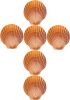
The remains of the Biblical Apostle James were, according to medieval legend, brought to Galicia for burial and the place was named 'Santiago de Compostela' (Santiago = Saint James)
No surprise that Santiago de Compostela is a centuries-old destination for pilgrims.

Scallop
A pecten shell is a type of exoskeleton of an invertebrate. 'Pecten' is Latin for 'comb', and used to describe several comb-like structures in biology. It differs from 'pectin', which is a chemical used as a gelling agent in food products. Remember this:-
Use pectin for gelling your jam, and use pecten for gelling your hair!
Pecten shells start life as homes to sea molluscs, and when their host dies, the shells lie provocatively on the sand waiting for some beachcomber to come along and say "Wow!" Then they're taken home, washed, and used as soap dishes for a couple of years before being thrown out with the household rubbish. Some fare better and become picture frames, lamps, jewellery, or musical instruments. And some are used to make a cross.
We shouldn't write-off such handicrafts as tacky ornaments - over 100 years ago, boxes covered in oriental shells were a popular import item for a Victorian shipping company; so popular in fact, that they named their company "Shell". Since then, the company has grown to be one of the most successful energy and petrochemical companies in the world.

Shell Group logo
Another reason the company decided on the pecten shell for its logo was because the family of an early financier, Mr Graham, had a coat of arms which included such an emblem. Mr Graham's ancestors had pilgrimaged to Santiago de Compostela, the tomb of St. James.
Today's Santiago de Compostela has the same casinos, nightclubs, brothels and drug gangs found in many large towns and cities, but also has the historical reminders of the town's religious importance. Pilgrims still visit, adding to the hundreds of thousands of tourists each year, which impose an unbearable nuisance on residents. So if you're thinking of going, please keep the previous sentence in mind as you continue reading this page.
In the Middle Ages or even before, pilgrims traditionally picked up a scallop shell from Galicia as a souvenir of their journey and evidence that they had visited St. James' shrine.
Pilgrimages to other sites had similar customs of bringing back souvenirs which were more than just mementos; they'd wear them as a cap badge, which served as a 'passport' to show bandits and local authorities they were passing in peace and meant no harm.
The shell could also be used as a scoop or spoon for the pilgrim to feed themself modestly at an abbey where they stopped for sustenance. The shell would be a sign to potential hosts that the pilgrim didn't expect much food.
"A bolle and a bagge
He bar by his syde
And hundred ampulles
On his hat seten
Signes of Synay,
And Shelles of Galice,
And many a conche
On his cloke,
And keys of Rome,
And the Vernycle before
For men sholde knowe
And se bi hise signes
Whom he sought hadde"
Piers Plowman by William Langland (c.1332 – c.1386)
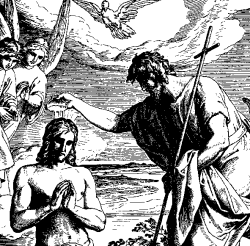
The shell also became a baptism symbol. It's been found in artwork discovered in ancient Christian catacombs and also in Renaissance art. Often John is depicted baptising Jesus by pouring water from a scallop shell.

MCK

MCN

MCSA
A shell symbol features in many family crests (for example, that of the late princess Diana), and prominently in the logo of the Methodist Church in Kenya (MCK) and the Methodist Church of Southern Africa (MCSA).
The Methodist Church Nigeria (MCN) logo shows a small shell beneath the Agnus Dei over an outline map of the country.
In addition to being a symbol for baptism, another reason for the scallop shell motif on Methodist logos may be from its appearance beneath a 1778 engraving of John Wesley, thus becoming a de facto family coat of arms.

A gold shell symbol was incorporated into the papal coat of arms of Benedict XVI for the following reasons:
- A pilgrim's badge. Benedict wished to follow the path trod by his predecessor, John Paul II, in spreading the Gospel around the world. Also, Benedict was connected with the Monastery of Schotten, Bavaria, which has a pilgrim's shell within its coat of arms.
- A baptism implement. Benedict was a strong believer in the importance of baptism.
- A legend. Benedict wrote his doctoral thesis on a legend attributed to St. Augustine. The story goes that Augustine, walking along the beach, met a child who was using a scallop shell to scoop up the sea into a hole in the sand. This revealed to Augustine the futility of trying to encompass the infinite and eternal nature of God within the confines of the limited human mind.
Many continue to tread the path and discover new things about themselves. As Piers Nicholson says on his website santiago-compostela.net: "You learn more about your feet than you would ever have thought possible!" and he adds more importantly: "And you also learn a lot about life."
Here's a poem he wrote on the journey in 2003.
The Camino
or A pilgrimage to Santiago in Spain
When we started, we did not know – exactly – why we were doing it
We had lives which were – more or less – satisfactory
We had friends known much of our lives
We had children – changed from chrysalis to butterflies
We had things:
things like machines
things like music
things like pictures
things like shelves full of books
things like money and pensions and security
We did not have one thing – and maybe that was why we started
When we started, we put one foot in front of the other
We still did not know – precisely – why we were doing it
The miles passed – many of them pleasantly
Our feet blistered and were slow to heal
Our ankles turned on loose stones
The rain beat its way through our clothes
The cold chilled the marrow of our bones
Some nights, refuge was hard to find
Some days, miles of hot dust had no fountains
When the first few of many long days had passed
We found – without words – that we no longer walked together
That together we spoke in our own tongues –
and often of things we had left behind where we began
That together we shut out new experience with the wall of our togetherness
That alone we spoke in other tongues and of our common experience
That alone we were open – open with interest and curiosity.
Often we met – with gladness – at the end of the day
To know our paths went on together was enough
When we got to the cathedral we sat down
We saw – through the eyes of those long before us
The blinding faith, the crucial thirst for salvation
The tower slowly closing off the sky
And we counted our blessings – several hundred of them
Starting with the kindness of ordinary people on the way
And with the warmth of other travellers on the road
Travellers not at all like us – not in age, not in origin, not in interests
But warm across all these distancings
And ending with the friendship and love
We had left behind where we began.
When we got to the sea at the end of the world
We sat down on the beach at sunset
We knew why we had done it
To know our lives less important than just one grain of sand
To know that we did not need the things we had left behind us
To know the we would nevertheless return to them
To know that we needed to be where we belonged
To know that kindness and friendship and love is all one needs
To know that we did not – after all – have to make this long journey to find this out
To know that – for us – it certainly helped.
(written near Sanguesa, Navarra, September 2003)
Copyright © Piers Nicholson 2003 on santiago-compostela.net
And finally...
...here are a couple of stories which have nothing to do with pilgrimages, but nevertheless are about men walking on the beach to pick up sea shells.
Inspiration #1
😄A woman lives with her henpecked husband in a house near the sea. "We'll have mussels for dinner tonight. Go down to the beach and gather some." she commands. "And be quick. It took you three hours last time."
Without saying a word, the man pulls on his coat, picks up the old metal bucket and trudges out of the house, down to the beach.
To his surprise, the beach is full of mussels and it takes only a few minutes to fill the bucket to the top. "That's nice" he thinks, "maybe I'll pop into the pub for a quick jar before I go back home." and off he goes to the local tavern.
"Half pint of beer" he says. "No, wait, make that a full pint. It's been a long time since I've had a drink." and the barman serves him his beer.
Sitting in the corner of the pub he catches sight of an old school buddy. "Hey! Long time no see. Come and join me." and the two men settle down with their beers and chat away about the good ol' days.
"Let's have another drink" says the friend, and the evening wears on
...and on.
"Closing time!" shouts the barman. "Oh no! She'll KILL me." cries the man. He picks up his bucket and races out of the door, down the road and back to his house.
As quietly as he can, he rushes up the steps to the front door. But the drink has taken its toll and he's not so steady on his feet. It only takes a slight trip on the last step to make him lose grip of the bucket handle. The metal bucket tumbles with a clang, scattering the contents all down the steps.
The door opens from within and his wife stands there, arms folded, steely eyes glaring at him.
The man slowly turns to look at the mussels and says "Come on, we're nearly there."
Inspiration #2
😄Hold a seashell to your ear and it will capture the ambient noise from around you and resonate in the cavities and curves of the inner walls of the shell. Or in simple English; you can hear the sea.
This (unlikely) story is about a man who made a fortune from holding a seashell to his ear.
Long before the days of portable devices for listening to music, a man is walking on the beach. He notices a shell on the sand, picks it up and holds it to his ear. "Wow!" he says "I can hear the sea."
He picks up another shell and puts it to his other ear. "Woah! Stereo!!!" which gives him a brilliant idea.
Rushing into the nearest shop he says "Hey! I've got a great product idea. I'm going to digitize these shells and make a fortune. Can you sell me a bag of these shells please?" "Sorry," says the shop assistant, "this is a food shop; we don't sell shells."
"Well," says the man, "do you have anything with a similar shape?" "We've got some round doughnuts. Will they do?" replies the shop assistant, and the man takes one and puts it to his ear. "No, these don't seem to work. Do you have anything else?"
"We've got these meat pies." replies the shop assistant, and the man takes one and puts it to his ear. Now, the meat pie is slightly warm and the meat inside is quietly simmering. "Not much volume with this" says the man, "do you have anything hotter?"
"How about this apple pie? It's straight out of the oven." And indeed it is. The man puts it to his ear.
The apple inside is sizzling away and the man exclaims "Success! I will use these and call my company: PIE-ON-EAR!"