Rope Cross
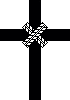

A fine example of a roped Toulouse Cross with eight crossed bands
(Click any image to enlarge)

A roped Nailed Cross with gemstomes
Around 2,000 years ago, a common way to a crucify people was to first plant a stipe (vertical post) into the ground. Before using the stipe, however, the victim would be scourged and beaten savagely before being pushed to the ground on his or her back. The arms were then outstretched and bound or nailed to a patibulum (beam). Finally, the patibulum was hoisted up, with the victim, and fastened to a mortice in the stipe.
The most expedient way to attach the patibulum would be with rope, therefore the Rope Cross (sometimes called a Corded Cross) reminds us of the brutal way that Jesus was crucified.
Mankind has a twisted imagination and over the years we have developed bizarre methods for killing fellow humans that annoy us. Stoning, crushing, poisoning, piercing, burning, electrocuting, drowning, asphyxiating... the list goes on.
Crucifixion is perhaps one of the cruelest forms of death. The victim must hang in pain that is excruciating (a word derived from 'crucifixion'); even more agonising if nails are used for the wrists and feet.
The victim also suffers the humiliation of being naked, beaten and wracked, whilst spectators jeer mockingly until death brings relief.

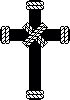
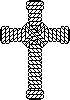
For the decorative Rope Cross, sometimes these are made entirely of cord, rope or cable. (See Braided Cross)
Other Rope Crosses show ropes wound around the ends of the arms. This sanitizes the Biblical account that nails were used to attach Jesus to the cross. Even so, bound limbs would be less painful and keep the victim conscious for more prolonged torture.
Heraldry
When the pattern is used in a coat of arms, the name "Rope Cross" can change to the more macho Cable Cross (Croix câblée) or Wire Cross.


Then imaginative styles can appear. The first cross on the right is seen on the Vandenbroeck family's coat of arms. The cross next to it graces Macedonian Church medals.
Such crosses are far removed from the rough wooden timbers used to crucify Jesus, but no less unrealistic as many crosses used in a Christian context.
For teachers
Solomon illustrates the strength of the three-ply rope in Ecclesiastes. Two strands are better than one, he explains, because they can support each other. And if a rope has a third strand, it is even stronger. (Indeed, a rope of three strands twisted together is stronger than the sum of three single strands.
How much stronger depends on many factors, including the chemical composition of the fibres and the way the strands are twisted, braided, or both. It also depends on whether the load is static or subject to shock, the weight and length of the rope, temperature, and other factors. But simply put, three strands twisted together produce a rope with a larger final diameter.
The outer fibres have different stresses from the inner fibres and this gives the thicker rope the advantage over three (thinner) individual strands. A strand will begin to break if it develops stress cracks which then propagate axially down the strand and radially, resulting in failure of the strand. When multiple strands are twisted together, each strand is able to stretch slightly and slip by one another, which makes the composite stronger than single strands which can only stretch axially.
Consider the analogy of friendship and marriage (and this is why, in our Alphabetical Index of crosses, the Friendship Cross brings you to this page). When two people are joined in love, if Christ is in their lives then like a three-ply cord, the marriage is strong. Conversely, untwist that cord, and the separate threads can easily snap. A marriage, alliance or friendship, not based upon God's laws and principles will not have the strength of true love
Tying the knot
Cords and knots are used symbolically in wedding rituals around the world; as in the Philippines for example.
It is said that "Two's company; three's a crowd". Well, with personal relationships, we all know that sometimes things don't work out as we would wish. Unlike a tripod, just two pins joined together would wobble. But adding a third part stabilises and gives strength. This is why Jesus is so important in our personal relationships with others.
Marriage Takes Three
I once thought marriage took
Just Two to make a go,
But now I am convinced
It takes the Lord also.
And not one marriage fails
Where Christ is asked to enter
As lovers come together
With Jesus at the centre.
But marriage seldom thrives,
And homes are incomplete,
till He is welcomed there
To help avoid defeat.
In homes where Christ is first
It's obvious to see,
Those unions really work,
For marriage still takes three.
Perry Tanksley
1984
Most ropes happen to be made with three strands and hawser-laid (with a right-handed twist). Rope can be a useful piece of realia for teachers looking for a way to explain the Holy Trinity. With a length of rope coloured red, yellow and blue for example, the red can represent the blood shed by Jesus on the cross, the yellow can represent the fire of the Holy Spirit, and the blue can represent the majesty of God the Father.
The indignation of crucifixion: Deut. 21:22-23
The nailing of Jesus: John 20:25, Col. 2:14. See also Passion Cross
The mocking of Jesus: Matt. 27:48, Luke 23:36. See also Arms of Christ
The triple-braided rope: Eccles. 4:12
A union without God: Deut. 13:6
If two's company and three's a crowd, what's four and five?
Nine, of course!
Red, Yellow and Blue: Usually in that order. Rarely 'Yellow, Blue and Red'. And that might be because we are familiar with the order of colours in the rainbow. Or it could be just another of life's great mysteries...


