Western Style Weddings Work in Japan
Seiyaku is neither an employer nor agent, but if you are looking for an opportunity to take part in wedding ceremonies, hopefully this page will provide some guidance about the following jobs:
Chapel assistant

An extremely important person in the chapel.
The Chapel Assistant appears to be just part of the 'furniture' as an attendant, but is actually the 'floor manager' for the ceremony. If anything unusual happens, the Chapel Assistant is the first person to know about it. Or should be!
An 'unusual' happening could easily escalate into a problem, and from there into a crisis. The Chapel Assistant's job is to identify such issues and nip them in the bud.
There are many minor details to watch out for: Are the groom's shoelaces tied, is the bride's necklace neatly aligned, or is anything out of place that might spoil the image.
There are often very young ring bearers and veil bearers. The Chapel Assistant loves children. Often they're little tykes but the Chapel Assistant's natural warmth for children melts them into little angels.
The Chapel Assistant:
- Greets the couple when they arrive at the chapel and is often involved in, or leads, the rehearsal
- Gives pre-ceremony instructions to the guests: where to sit, how not to disturb while taking photographs, to switch off mobile phones, etc.
- Keeps an eye on any ring bearer or veil bearer, especially if they're very young
- Inconspicuously assists during the ceremony by holding the bride's gloves and bouquet during the ring exchange
- Ensures the long train on the bride's dress doesn't get snagged when negotiating around furniture
- Generally moves around like a ninja, unseen, yet all-seeing
...the list goes on
The Chapel Assistant is a movie's creative director, a therapist, life coach and diplomat. Responsive and proactive. She knows exactly when to step in and when not to interfere. The Chapel Assistant is Flexible (note the capital "F"), ready to adapt to any requirement, professional and calm, and above all, does her utmost to make sure the couple enjoy the best wedding they could ever dream of.
And yes, it's a 'she', since the chapel assistant is the person who will attend to the bride's personal needs more than the groom's. The chapel assistant is also invariably Japanese, for the reasons stated below.
Organist


A very important person in the chapel, the Organist drives the pace of the ceremony. The whole atmosphere and emotion can be altered by a subtle change in the Organist's performance.
The Organist's timing is perfect. When playing background music, during the ring exchange for example, the Organist somehow manages to finish the piece exactly as the activity ends — however elastic that timing might be. This is a challenge, yet satisfying when Organist gets it right.
If any incident interrupts the flow of the ceremony, the Organist is ready at a moment's notice to play an interlude while the problem is resolved.
The problem may be a delayed bride's entrance; perhaps due to a final adjustment to the bouquet, her hair, or some other last minute preparation to effect a grand entrance. Or it may be the several minutes needed to persuade the five-year-old ring boy that he really does want to walk down the aisle carrying the ring cushion with a hundred adults watching him.
Sometimes the problem is more serious; one of the couple may faint. In this case, the ceremony will be suspended for a short while. Guests will naturally be concerned and the Organist will play something appropriate to soothe the atmosphere.
Whatever the emergency is, the Organist has no idea how long the delay will be. If the interlude is just 10 seconds, the the Organist stretch things with a few thoughtful chords. If it's longer — well, that's where improvisation and cadential wanderings come into play.. This, is the challenge.
But usually the ceremony proceeds without incident. The Organist plays background music as the guests enter, the fanfare for bride's entrance, the accompaniment for the hymns, background music during the bible reading, ring exchange, etc., and the final spectacular recessional.
The Organists finishes each wedding with a well-deserved personal feeling of satisfaction of having done her best performance for the couple.

Soloist


The Soloist has undoubtedly one of the most critically important roles in the ceremony. Whether as a singer, harpist, flautist, cellist or any other musician, the Soloist provides an elegant and sophisticated polish to the ceremony. Until the Soloist performs, all eyes are on the bride and groom. And whilst they do their best to look and behave like royalty, they're usually inexperienced at being centre stage. Here, the Soloist adds sparkle. The Soloist shines!
The Soloist's performance is typically something like Bach's Suite No. 1 for the cellist, or Handel's Dank sei Dir, Herr, Amazing Grace, or Ave Maria, for a singer. Occasionally the couple have a special request which might not be in the Soloist's repertoire and must be practised beforehand to the point that delivery is perfect. Mistakes cannot be tolerated during the ceremony.
Almost invariably there's no applause after a performance; just a few seconds silence showing the Soloist has honoured the deep emotion, the pomp and circumstance.
But the Soloist's performance doesn't end there; other duties are often performed. See 'Choir and Orchestra' below.
Gospel Singer

Meet JonnyD, one of the more popular Gospel singers at weddings in Japan. jonmedley.com
Can you match that standard?
Even modern chapels can have a somewhat medieval atmosphere; with the candles, pipe organ, pastoral robes.
So a splash of Gospel music can be a sharp contrast to an otherwise potentially stuffy atmosphere. The song doesn't have to be boisterous; a soothing ballad may be required.
The singer might be asked to suggest a piece but almost invariably the wedding venue decides on something to suit their desired theme. And to the professional singer, this doesn't matter at all. As JonnyD says, the singer's job is to "touch your heart with every note, spreading love and happiness with his spirit, while bringing joy to everyone's soul."
Let's get one thing clear about that last statement: Bringing joy to the soul is way beyond just a performance; it is a spiritual encounter. So be honest with yourself: Is this job for you?
Choir and Orchestra

A small choir or chamber orchestra play a tremendously important role in the ceremony. Singers are typically opera-trained Japanese. It's rare for guests to excel in hymn singing; they're too busy savouring the atmosphere. The musicians must somehow compensate and fill the chapel with sound. As members of a group, they blend and harmonise perfectly with their peers, even if it's their debut or if the accompaniment is unusual.
Some musical pieces can be a bit awkward since most have been written for a different setting; perhaps a grand concert hall with a huge chorus and a full orchestra. Some music has been written for a different culture which may have an unfamiliar beat, or for singers, some foreign words may be difficult to pronounce.
A less obvious challenge is caused by the opposite: Many musical pieces are familiar and can be performed on autopilot, without even looking at the score. If the musician is going to sound like a robot then the ceremony would be better off using a pre-recording. Live performance with appropriate piquancy is the mark of a professional.
In addition to their obvious role, there's another critical part that musicians play: 'Music staff' are frequently called on to assist as instructors for the rehearsal, usher guests, and generally steward as and when required. Such tasks often don't come naturally and can cause unwanted stress, just before their musical performance.
That said, you’ve likely tackled these tasks before — remember the early days of staging your own shows? So don’t worry... the extra ‘chores’ just keep things interesting.
Pastor
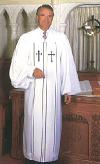
The Pastor conducts the wedding and consequently has an important role in the ceremony.
But don't get carried away by the term "important role". This is not a theatrical play and even if it was, the pastor is just a stagehand, not a protagonist. So-called "method acting" doesn't work at a wedding. This is real life.
The pastor must get the right balance between being strong enough to appropriately direct a group of perhaps 100 guests, whilst focusing on the needs of the couple standing in front of him. He's fully aware of the profound nature of the ceremony, yet makes the event lively and enjoyable for everyone.
Sadly, in the past, some rather dubious characters took advantage of the fashion to use foreign pastors, seeing an opportunity of a lucrative side-line. Not only were some of these men breaking the law by working outside their visa restrictions, but also the strength of their Christian faith was suspect. Fortunately for the couples, it's only God who marries people and any lack of a celebrant's Christian faith is no ground for doubt about the validity of the marriage.
That said, a reputable wedding agency will not accept anyone they suspect has questionable faith or insufficient knowledge of the Bible to successfully perform the pre-wedding counselling with the couple.
Bottom line: The easy money has now gone. Since around the late 1990s demand has fallen, which has led to lower pay rates. Wedding pastors today conduct weddings because they love the work rather than for any financial reward. In addition, the Japanese immigration authorities have increased vigilance and penalised wedding companies caught employing people without proper credentials, which has led to stricter selection criteria.
Photographer, sound engineer, hair stylist, beautician, flower arranger, wedding planner, caterer, etc.
Many other professionals are essential for a successful wedding ceremony but at the moment, this page is limited to the above jobs. We plan to add more later so please check back here from time to time. If you have information you'd like to share, please email the link below.
Japanese-only staff
One point perhaps worth mentioning, however, is that most roles are generally undertaken by Japanese staff.
Foreign celebrants, singers and musicians can be used, since their foreignness can provide an exotic enhancement to a wedding. But other staff are mainly Japanese, or at least have an Asian appearance, and blend in with the furniture, unseen, which is difficult for Westerners.
Keep in mind; if a customer doesn't want something, even if it is brilliant, then they won't buy it.
Is this job for you?
You may have noticed in each section above, many roles are described as 'very important'. In fact, every role is equally important. Everybody works as a team. Nobody in the team is Number One. So if you consider wedding work mainly as your opportunity to advertise your wonderful talents, then this job is not for you.
For a pastor, even though every role is equally important, the pastor may be viewed by couples and their guests as commanding the central role. Consequently, wedding agencies and venues are very cautious when appointing somebody for that position.
If you present yourself as minister because you've downloaded an 'ordination', 'licence', 'certificate', etc., from an online 'seminary', 'monastery' or similar ordination mill, then you'll find it very difficult to show genuine sincerity for the work. You are also likely to be rejected by reputable wedding agencies/venues if you're from a church which is considered (by them) to be dubious or a cult. And even a candidate with an acceptable ecclesiastical background in a mainstream church will be unsuitable if the agency/venue suspects the person would focus the spotlight themself instead of the couple and their families, and/or have a problem with humility.
But if you see yourself as a professional team member, whose Number One concern is to provide the best, the very best, for a couple you don't know and will probably never see again, then the job might be for you.
As pointed out at the top of this page, Seiyaku is neither an employer nor agent. Please don't write to us seeking work - we don't have any to offer. Contact a reputable wedding agency instead.


