Processional Cross
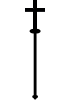

Long before Christianity, standards were carried to rally and lead warriors. Roman army standards were symbols of honour, held in awe and fiercely protected. These tall poles held impressive insignia and symbols aloft. They were often adorned with animal skins or animal heads bearing teeth. The standards were carried by officers so the troops could see them above the action. This helped the soldiers to stay close to one-another and such cohesiveness enhanced the strength of the unit.
For Christians, St. Augustine, first archbishop of Canterbury (not St. Augustine of Hippo) is often credited as introducing the concept of a Processional Cross in the 6th century, using it like a military standard to lead the procession in some of the church rituals.
A couple of hundred years later, Saint Bede wrote Historia ecclesiastica gentis Anglorum (The Ecclesiastical History of the English People) in which he describes St. Augustine approaching Ethelbert 'carrying a silver cross for a standard'.
Design
The cross is often surmounted on a staff or handle, long enough for all to see. Often the handle is removable and when the procession approaches the altar, the handle is detached and the cross is placed on the altar. The foot of the cross may be pointed to fit into the handle and then into a base on the altar. Alternatively, the cross may be transferred to a holder at the back of the altar, hung on a wall behind the altar, or placed somewhere in the vicinity.
The material used to manufacture the cross, and its design, are of much less importance than its function. An exception to this might be when the cross is a reliquary. The style is often a simple Latin Cross on a staff, although a Tau Cross might also be used or some other cross style. Indeed, it doesn't have to be an actual cross form. An icon, a palm leaf, a flag, or anything at all, can be used to lead the procession.
When the cross is very large, representing the True Cross, it is borne on the shoulder with the base dragging on the floor as a Portate Cross.
Positioning
Processional Crosses in Roman Catholic churches usually bear a corpus. Other denominations, if they use such a cross, prefer one without a corpus. Where there is a corpus, the cross-bearer (in Eastern Orthodox monasticism: Stavrophore) holds the cross so that the corpus is turned in the direction in which the procession is moving. This symbolises Christ leading the procession.
An exception to this is when an archbishop is at the head of the procession, the corpus is facing the archbishop so that he 'can always keep his eyes on Jesus'.
Examples
Below, we see processions in the Notre Dame Cathedral, Paris, France, and at St. Catherine of Siena Church, Trumbull, Connecticut, USA.


We are indebted to Sean M. Wright for allowing us to copy some of the above information from his book: The Very Stones Will Cry Out


