Roman Empire, Railways & Space Shuttle
Three science graduates are talking one day; one from Russia, one from America, and one from La La Land.
Russian: "We were the first in space!"
American: "We were the first on the moon!"
La La Landian: "So what? We're going to be the first on the Sun!"
The Russian and American look at each other, slowly shaking their heads.
Russian: "You can't land on the Sun, you silly man, you'll burn up!"
La La Landian: "We're not stupid, you know. We're going at night!"
Here is some tongue-in-cheek evidence to show that the design for the Space Shuttle's rocket motor began thousands of years ago by Roman warriors.
The international standard railway gauge (distance between the rails) is 143.5 cm (or a smidgen under 4 feet 8½ inches for the metrically challenged). A strikingly-odd width but is, nevertheless, the standard gauge. Why? Because that's the way they built them in Britain, and the Brits built the railways in the US, Japan and many other countries around the world as they desperately tried to revive the expansion of their crumbling empire.
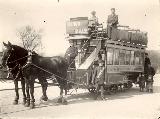
The gauge is a legacy of the earlier tramways. Railway engineers used the same tramway jigs and tools for building the railway wagons. The tram coaches in turn, had been built using the standard jigs used to build horse-drawn stage-coaches.
Horse-drawn carts had that wheel spacing because it was the standard spacing of the wheel ruts gouged in the roads.
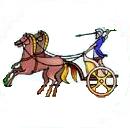
Long distance roads in Britain (and elsewhere in Europe), were first built by the Romans as they expanded their empire. The Romans had earlier experimented with the design of battle chariots and found that two horses, side-by-side, was the best arrangement in terms of speed and maneuverability. Although their engines were only 2HP, we shouldn't under-estimate the importance of these early test-pilots. Their findings fixed the width of chariots, and hence ruts in the road.
Now let's trot forward two thousand years to the design of the Space Shuttle,
The Tunnel
Three men were standing in the middle of a railway tunnel.
The pessimist saw it was dark
The optimist saw the light at the end of the tunnel
The realist saw an express train coming
The express train driver saw three silly men standing on the line
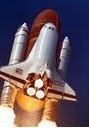
You may have noticed there were two huge ancillary rockets on the sides of the main fuel tank. These were known as 'reusable solid rocket boosters' and were made by a killing-machine firm called ATK Thiokol in Utah. The assembly plant for these boosters was located on western side of the Rocky Mountains and to transport them to the Kennedy Space Center, rail was the cheapest and quickest method. The line from the factory ran through a tunnel so the booster rockets had to be made smaller than the tunnel. This tunnel was only a bit wider than the track, and therefore the rocket design had to take this into consideration.
So there we have it. Today's space travellers owe the design of the Shuttle's rocket motor to Ancient Roman test-pilots.
(Variations of the above pop up frequently on the internet. Plausible, but useless information.)


