Mosaic Cross
also called the Trononné or Dismembered Cross
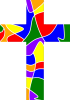
Mosaic has two definitions:
- It is a decoration or picture or made from pieces of pieces of inlaid stone, glass, etc., almost invariably in different colours.

These pieces and colours are usually arranged arbitrarily, although in some applications, like the pixels you are seeing on your PC or smartphone screen now, each piece has a deliberate colour and position to form a larger picture. This technology is also used to give a mosaic effect on an image of somebody's face, to hide their identity. The word mosaic is used as a noun, adjective or verb.
- The other meaning is always as an adjective and the word is always capitalised. It is used to relate to the prophet Moses (as in Mosaic Law, Mosaic period, Mosaic Judaism, etc.)
Since Moses was born well over 1,000 years before the Cross became a Christian symbol, the former definition is understood when referring to the 'mosaic cross', that is, a cross brightened up with small coloured segments. (See also Rainbow Cross.)


The poster, designed by a visitor from Singapore, showed a mosaic of 50 pieces, each representing a year since the centre's foundation. Over those years, people from many more than 50 countries have worshipped at the chapel, showing, as the artwork does, how the Church comprises the coming together of people. Whether they come from different parts of the world or have differences in wealth, health, age, colour, gender, and so on, they all worship the same Christ.
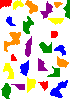
And this leads us to an appealing game for children. As a Sunday school teaching aid, it can show how an artist can move the randomly arranged broken pieces (shown here on the left) and make a beautiful Mosaic Cross (shown at the top of this page). In the same way, Jesus can take the broken pieces of our lives and make us whole. (See Mosaic Cross worksheet)
Although a Mosaic Cross is divided into pieces, the profile is preserved.
Just as a rainbow is the sum of all its colours, the human race is the sum of all people. And Jesus died for us all.


