O Come, All Ye Faithful
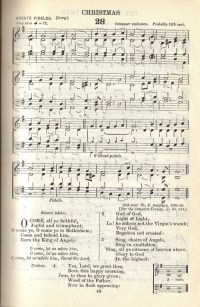
O Come, All Ye Faithful is a Christmas carol of ... err, how can I say the word 'joy' without sounding too religious? How about 'happiness', 'elation', and general 'festive gaiety'?
We know it's a festive song, heard around the time we do our Christmas shopping. Jolly background music in shopping malls and pedestrianized streets, urging us to be happy. To spend, spend, spend. Shop for our loved ones. Shop for our work colleagues. Shop for ourselves.
Listen to the music, be happy, and spend.
The carol was written hundreds of years before shopping malls existed. It was written about an event that took place two thousand years ago. In fact, it was written about a prophecy which was made thousands of years before that.
And as you'll read below, it might also have been written with a coded political message.
by Douglas Hargreaves
Sydney, NSW
John Wade
Englishman John Francis Wade was born in 1711 either in England or in Douai, northeast France. At that time, there were a considerable number of academics from Oxford with prominent roles at Douai University.
The early 18th century was also a time of political and military upheaval in the area. The town had been controlled by Louis XIV but after the siege of the Duke of Marlborough in 1710, the English took control. Then it was retaken by France in 1711. If Wade was born in Douai, he was born at a difficult time.
He grew up in England and with fellow Catholics, fled to Douai to escape the Jacobite Rising of 1745. Douai had become a refuge for English Catholics and he lived there until he died, just a couple of years before the French Revolution. It seems that for much of Wade's life, his educated Catholic family background would have subjected him to uncomfortable times.
Wade taught music at an English college in Douai and made extra income from hand-copying chant music for the chapels of wealthy families. Some of these manuscripts were published in 1751 as Cantus Diversi pro Dominicis et Festis per annum.
A couple of years before fleeing England, he wrote the words to the Christmas carol, Adeste fideles (O Come, All Ye Faithful). Wade wrote four stanzas (1, 2, 7 & 8) and by the early 19th century four additional ones were written. Three of these (3, 5 & 6) were probably composed by Abbé Etienne Jean François Borderies; the author of stanza 4 is unknown.
| 1 | Adeste fideles,
laeti triumphantes venite, venite in Bethlehem Natum videte, Regem angelorum |
| Refrain | Venite adoremus, Venite adoremus,
Venite adoremus, Dominum |
| 2 | Deum de Deo,
lumen ad lumine, gestant puellae viscera, Deum verum, genitum non factum. Refrain |
| 3 | En grege relicto,
humiles ad cunas, vocati pastores appropiant. et nos ovanti gradu festinemus, Refrain |
| 4 | Stella duce, Magi
Christum adorantes Aurum, tus, et myrrham dant munera. Iesu infanti Corda praebeamus; Refrain |
| 5 | Aeterni Parentis
splendorem aeternum, Velatum sub carne videbimus; Deum infantem pannis involutem. Refrain |
| 6 | Pro nobis egenum
et foeno cubantem, Piis foveamus amplexibus. Sic nos amantem quis non redamaret? Refrain |
| 7 | cantet nunc 'Io'
chorus angelorum; cantet nunc aula caelestium, Gloria in excelsis Deo. Refrain |
| 8 | Ergo qui natus
die hodierna Iesu tibi sit gloria Patris aeterni Verbum caro factum. Refrain |
The timing and circumstances of penning these words have led to the speculation that it was actually a coded political message, as we explain below.
Bennett Zon
In 2008, Prof. Bennett Zon, Durham University's head of music and expert in Post-Reformation liturgical music, suggested there are references in the carol's lyrics to Charles III (Bonnie Prince Charlie). Charles was the exiled Jacobite claimant to the thrones of Great Britain and Ireland. He was the grandson of England's last Catholic monarch, James II and born on 31 December, very close to Christmas.
The first verse of the hymn in English:
O come ye, O come ye, to Bethlehem.
Come and behold Him, born the King of angels;
or in Latin:
venite, venite in Bethlehem
Natum videte, Regem angelorum
Fideles (1st line) means 'faithful', and could easily refer to the rallying faithful Catholic Jacobites. Bethlehem (2nd line) was the Jacobite cipher for England, and Angelorum (3rd line) was an apparently well-known pun for Anglorum ('of the English'). So the first verse could be translated as:
O come ye, O come ye, to England.
Come and behold Him, born (at Christmas time) the King of the English;
In English, it doesn't match the melody's irregular metre but could have matched the sentiment of people such as Wade, who'd been under sufficient pressure to exile himself to France.
Prof. Zon accepts we will never know what was in Wade's mind when he wrote the words. What is more relevant for us today, is what's in our minds when we sing these words.
Frederick Oakeley
The English translation of Wade's original four stanzas is attributed to an Anglican priest, Frederick Oakeley (in 1841), who later converted to Roman Catholicism. He wrote the English verses for the Margaret Street Chapel in London. A translation also appeared in F H Murray's 'Hymnal for Use in the English Church' (1852) and William Mercer's 'Church Psalter and Hymn Book' (1854).
Stanzas 3, 4 and 6 were translated by W T Brooke for the Altar Hymnal (1884). The English for Stanza 5 has not yet appeared in print.
And so it is we have the following translations for today:
| 1 | O come, all ye faithful,
joyful and triumphant, O come ye, O come ye, to Bethlehem. Come and behold Him, born the King of angels; |
| Refrain | O come, let us adore Him,
O come, let us adore Him, O come, let us adore Him, Christ the Lord. |
| 2 | God of God,
Light of Light, Lo, he abhors not the Virgin's womb; Very God, Begotten, not created: Refrain |
| 3 | See how the shepherds
Summoned to his cradle, Leaving their flocks, draw nigh to gaze; We too will thither Bend our joyful footsteps: Refrain |
| 4 | Lo! star led chieftains,
Magi, Christ adoring, Offer Him incense, gold, and myrrh; We to the Christ Child bring our hearts' oblations. Refrain |
| 5 | (Verse 5 was not translated from Latin) |
| 6 | Child, for us sinners
poor and in the manger, We would embrace Thee, with love and awe; Who would not love Thee, loving us so dearly? Refrain |
| 7 | Sing, choirs of angels,
Sing in exultation, Sing, all ye citizens of heaven above: 'Glory to God In the highest:' Refrain |
| 8 | Yea, Lord, we greet thee,
Born this happy morning; Jesu, to thee be glory given: Word of the Father, Now in flesh appearing: Refrain |
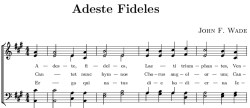
The music has been attributed to various writers, including Wade and another Englishman, John Reading, in the early 18th century
(Click image for full score)
As a Christmas Carol
The hymn refers to Luke 2:4-7 (1st stanza), Luke 2:13-14 (3rd stanza), and John 1:14 (4th stanza), and is one of the most common carols sung at Christmas festivals.
The word 'carol' (like 'choral' and 'chorus') is derived from Old French carole, a circle dance accompanied by singers and particularly popular in the Middle Ages. They fell out of favour following the Protestant Reformation, along with many other Roman Catholic traditions. But music is such a natural part of man's psyche that the foot-tapping was soon tolerated again, and as more and more attractive songs and music were produced, the Church began actively encouraging their use.
All kinds of people sing; to celebrate, to console, to encourage and to praise. Football crowds and warriors chant and sing in unison. Mothers croon their babies to sleep. Pentecostalists engage in glossolalia to express their religious ecstasy. Cats purrrr‑r‑r. There is nothing unnatural about expressing one's feeling through song.
And what a song this is! 'O Come, All Ye Faithful' is announcing the birth of Jesus into the world; a gift from God.
Be joyful. It's the middle of winter (in the northern hemisphere, anyway) cold and dark. Food is scarce and fuel is rationed, water wells are frozen, and it's the peak season for ailments and death. And yet, at this time, we remember the birth of Jesus in Bethlehem. Born to be King of angels. Come and behold Him. Focus your mind on this wonderful event.
Wonderful in many respects. Here we see the Saviour of mankind, arriving on earth to fulfil the Old Testament prophecies, to teach us, and to pay the price for our sin.
As we all know, and as many lucky people have witnessed first-hand, the birth of any child is quite miraculous. Yet this baby Jesus, arriving as King of Angels and Saviour of mankind, arrives in the humblest of settings; a stable. God chose the birth of His Son to take place, not in a grand palace with clean water and skilled midwives, but in a humble, dirty and cold stable, late at night. No midwives; just a few unwashed shepherds.
These witnesses had been told what to expect. They were given the wonderful privilege of being amongst the first to see the Messiah. Word of the Father, now in flesh appearing.
No wonder the carol includes "Glory to God in the highest"!
One of the most popular stories of the French Revolution; Les Misérables


