Burial Cross
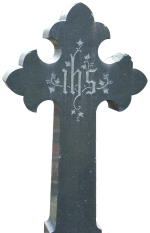
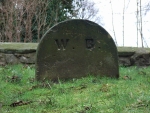
(Click either image to enlarge)
A Burial Cross, Grave Cross or Rest In Peace (R.I.P.) Cross marks the place where somebody is buried.
For sure, when we die, we don't smell very nice. (Many of us don't smell so nice when alive, either.) This is nature's way of protecting the living, warning us away from possible infectious disease by making decomposing corpses unpleasant to have around. Since Adam's time, we have dug holes, deposited bodies, and covered them up.
Burial is also a mark of respect for the deceased. The grave is the last resting place of the physical person and its precise location can be important to family and friends. Consequently, a stone marker is used in most cultures that bury their dead.
For Christian cultures, the tradition has been to use a stone cross marker. The resilience of stone reminds the bereaved that the soul does indeed, live on into eternity.
The modern cross (above left) was cut from marble; a relatively easy process with today's modern machinery. Each arm has a Fleur de Lis and the inscription is IHS. Earlier grave markers, reflecting the limitation of machinery and perhaps scarcity of masons, were much simpler and showed just the deceased's initials (above right).

The faster you get, the faster you go
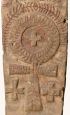
The cross is so ubiquitous in graveyards that it has become a symbol for death, as shown by the small crosses in the advertising campaign to reduce driving speed.
In fact, the Christian cross is really a symbol of life. After death, Christians (and many of those with other faiths) believe the Messiah will return and take his followers to Paradise. The Bible details this quite clearly, even to the point of assuring us that Christ will return from the east, which is why traditionally people are buried with their feet pointing eastward so they can be raised facing Christ to welcome him on his return.
Crosses as headstones, or headstones with crosses, come in all shapes and sizes. And many of them tell interesting stories.
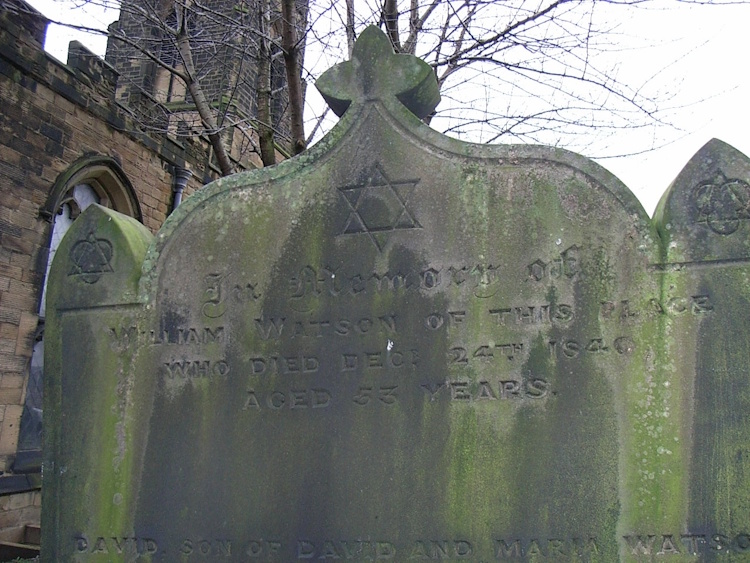
This photo shows the top half of a grave marker in the burial grounds of an old Anglican church in the north of England.
Looking at the very top of the stone we see an unremarkable fleurie or budded symbol; not uncommon in neogothic churches and graveyards, and usually represents the Holy Trinity in a Christian setting such as this.
But what about the symbols carved near the top? (Click photo to enlarge) Are they just a whim of the engraver? Quite possibly, but if they do mean something, what?
At first sight, the carving in the centre looks like a Jewish Star of David. But this is unusual to find in a Christian graveyard; especially since the top left/right triangles enforce the Trinity concept, which is rejected by the Jewish faith. In any case, the Star of David only became a popular Jewish symbol in the UK in the late 19th century, many years after this gravestone was carved, so a Jewish connection is unlikely.
We've had one or two suggestions that triangles might be Pagan and that the top left / right triangles represent male and female. Indeed, as viewers of the daVinci Code movie will have seen, the Star of David can mean the divine union of male and female energy, where the male is represented by the upper triangle ('blade') and the female by the lower one ('chalice').
Quite possible but again, rather out of place in this context.
Another idea proffered is that the star is a Masonic symbol. Stars are common in Freemasonry but usually they are pentagrams. And as you know, Masonic symbols are deemed inappropriate for consecrated churchyards.

Chinese Checkers board

Hexagram
Was the deceased, Mr William Watson, an expert in Chinese Checkers? Or a mathematician? In our school days, most of us probably never appreciated that πr2 would be so critical to remember in later life. But if we did manage to stay awake during those lectures, then we might recall that two equilateral triangles give us a representation of G2, which, having 12 roots, forms the vertices of a hexagram. (Make a note of that - you never know when you might need it.)
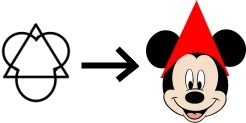
We also dismiss the notion that the top left/right shapes were outlines of Mickey Mouse wearing a pointy hat; not only because that's too silly, but also because the gravestone is early 19th century and Mickey Mouse didn't appear until 1928. Yet bizarrely, this leads us to one of two most likely explanations: The date.
- If you click on the headstone photo to enlarge it, you can see that Mr Watson died on 24th December 1840 - Christmas Eve. What a wonderful tribute for Mr Watson, to mark his headstone with a Bethlehem Star, the Christian symbol associated with New Life.
- An alternative idea is from the inscription lower down the stone, which says: "David son of David and Maria Williams ...".
Somebody named Davy in Canada kindly wrote to say that he, and no doubt many other Davids, often use the Star of David as a sort of family logo. However, as mentioned above, the Star of David was not common in the UK when this particular deceased was laid to rest.
Even so, the symbol has been used to decorate Christian churches for hundreds of years as a family logo – not only for Davids, but for all those in the family of Christ. In this context the logo is, of course, the light of Christ.
For everybody, named David or not, mathematicians, Masons and Pagans, that simple star shape reminds us of the birth of Jesus, who came to this world to teach us something infinitely more valuable than Pythagoras did. Jesus also came to this world to give us the opportunity for Eternal Life.
In addition to the star's symbolic association with resurrection, a star on a grave marker symbolises the continued existence of loved ones. Like stars in the sky, they are out of reach yet it is clear that they exist. Stars lift our eyes towards heaven.
The six-pointed star can be seen in some stained-glass windows of Christian churches (for example, in the ceiling of the Washington National Cathedral) and is often called the Star of Creation. The carving on this grave stone reminds us that the light of Jesus is not restricted to those born in the Jewish faith, the Masons, Pagans, Hindus, or anyone else. Absolutely anyone can see this light.
See also Churchyard Cross, Funeral Cross and Wreath Cross.
"Fish and guests smell after three days"; a saying attributed to Benjamin Franklin, Oscar Wilde, and John Lyly's Euphues & His England, II. 81, 1580.
Can people be raised if they have been cremated? Well, since God created man from absolutely nothing, recreating man from something would be dead easy; whether it was from ashes, dust, or even just the historical fact of man's existence.


